This morning Sambor (pronouced Sambo) and I visited the Bassac community, which is a slum neighborhood on the edge of Phnom Penh. The Bassac Theater, destroyed by a mysterious fire some years ago, was once an importatn venue for traditional Cambodian drama and the music that accompanied it. Many of the Cambodian Living Arts (CLA) master teachers live there along with their students, and many of their classes are held their too.
Sambor, a young Cambodian man who works for CLA, was kind enough to translate for me when meeting with thew masters and their students. We parked the car and walked through the dirt and gravel streets of the community, which mostly consists of corrugated metal and wood homes, with many familky members crowded into each. The poverty heree has no equivalent in the United States, and I have to constantly remind myself that so much of humanity lives on as little as these people do. And it makes it all the more remarkable that this is the focus of a renewal of the arts in Cambodia.
Sambor and I first went to visit Tep Mori's pin peat class. It was held in a tile-floored room, and there were about a dozen young students sitting on the floor with their instruments. Pin peat is a form of court music, used for formal ceremonies as well as certain dances in Cambodia. The ensemble typically consists of several large drums (sko thom), three or four wooden xylophones (roneat), and several circular metallophones (gong). The students were mostly girls, between nine and fifteen years old, and they played together extremely well. All the songs they know they learned by rote memorization from their teacher, as no notation system is widely used in Cambodia. When I asked them what they enjoyed most about studying traditional music, the students replied that they got a chance to learn "precious knowledge"about their culture from great teachers. I think all too often I have taken for granted what I have learned in school, but the spirit of these students reminded me how precious it is to learn. Tep Mori had clearly trained her young students very well, and she remarked how important it is to pass down the musical traditions to the next generation.
We then headed over to Kong Nai's house. Blind from the age of four, Kong Nai began to study chapei dong veng when he was thirteen at the behest of his uncle, who knew music would be a possible profession for someone who had lost his sight. His musical gifts are apparent in his dynamic chapei playing and in his soulful, improvised song. He's kind of a Cambodian blues man, and he often commands a lively social scene on his front porch. Kong Nai talked about his music for a little while, though it was hard to get an idea of how his class was run. One the whole, however, he displayed a much more casual and easy-going attitude than the other masters.
Sambor and I then went to visit Ki Mum's yike class, which was held on the third floor of an appartment building in dangerously poor repair. The class had about twenty-five students, with an even mix of girls and boys, ranging in age from nine to eighteen. Divided into groups of instrumentalists, singers, and dancers, the class performed a lengthly and complex piece. They sang and danced with vibrant enthusiasm, and I realized how wonderful it was to have young people dedicated to learning such ancient music. They studied six days a week to learn the songs and dances. I don't know enough about dance to write about it coherently, but I observe that Cambodian dance is very grounded in approach and prominently features highly stylized hand gestures, to the extent that the hands are almost always the center of attention. The more time I spend around this music and dance, the more I realize how much I love it.
The last class we visited was that of Ieng Sithul, a master teacher of wedding music. Because he is currently performing in the United States, his class was taught by two assistants, including Ieng's wife. This was the largest class I visited, with about forty students. It was also the most disciplined class, and I was deeply touched when they all stood up as we entered the room, palms joined in the traditional Khmer greeting. Wedding music has a particularly joyful sound, and the students played and sang with evident mirth and concentration. These were truly some of the best young musicians I had ever seen, and I was equally impressed with their dancing. For such a young program, the students seemed to be exceptionally well-trained.
After I had the chance to ask them questions about their art, the students asked me why I had come all the way to Cambodia to study Khmer music for a year. This was the first time I really had to think about this question, and the first time I had an experience that really showed me the answer. Music in Cambodia is not separate from the other arts, religions and the culture in general. Although the continuity of Cambodia's musical tradition was severely damaged by the Khmer Rouge and remains under threat by a lessening interest in traditional arts among the youth, I cannot hope to understand the culture withou understanding the music, and vice versa. When I come back, I will not know enough to really teach about Khmer music, but I think I will get a sense of how intertwined music and culture are, and how important music is to a healthy sense of identity and meaning in a country whose tragic history rendered life increasingly meaningless and painful. Music redeems us, and it challenges us to continually create new life and light where there was only death and darkness before.
Thursday, August 25, 2005

Wednesday, August 24, 2005
A Change in Pace
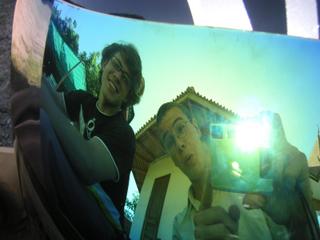
Things have gotten a lot busier recently. Yesterday, using my new motorcycle helmet (below),
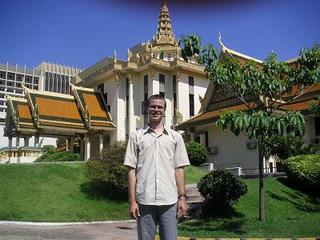
Parker, Beau and I went to visit the Buddhist Institute. The library they have is a fantastic place to study and do research, and I have inquired as to whether classes are available and if I might find support for my project there. The building itself is quite handsome, although there is a gigantic casino located right next door.
Today, I a m going to visit four masters in CLA's program and then head over to the studio to help out with the recording session. Yesterday, when meeting with Yun Theara, the Cambodian multi-instrumentalist and professor of the Royal University of Fine Arts, it looked like I would have to play bass on the album, but fortunately it looks like my role will be to take pictures for the liner notes. I'll try to report back after today.

Parker, Beau and I went to visit the Buddhist Institute. The library they have is a fantastic place to study and do research, and I have inquired as to whether classes are available and if I might find support for my project there. The building itself is quite handsome, although there is a gigantic casino located right next door.

Today, I a m going to visit four masters in CLA's program and then head over to the studio to help out with the recording session. Yesterday, when meeting with Yun Theara, the Cambodian multi-instrumentalist and professor of the Royal University of Fine Arts, it looked like I would have to play bass on the album, but fortunately it looks like my role will be to take pictures for the liner notes. I'll try to report back after today.
Tuesday, August 23, 2005
A Restful Change in Plans
I was planning to go to visit the Bassac community and Tep Mori today, but the car broke down without notice, so I ended up waiting on the street for about an hour. As it turned out, this was a great way to watch how life unfolds on a sidewalk in Phnom Penh. Children, some just learning to walk, roamed the sidewalks with their friends. Women sat outside their shops and chatted. Moto drivers took naps on their bikes in the shade. Monks in bright orange robes frequently passed by on their to Wat Unnalom. Trucks, buses, motos, cyclos (pedicabs), bicycles, and dogs all came by.
The time passed relatively quickly. One thing I've noticed about life in Cambodia is that people never seem to be bored. When there's nothing to do, even for hours on end, this is no cause for complaint. Rest is appreciated, especially in such hot weather and with hard work to do.
Today, Parker and I are planning on visiting the Buddhist Institute in Phnom Penh, which offers graduate study of Buddhist philosophy. And tomorrow it looks like I'll have a chance to meet four of the CLA masters in the Bassac community, including Tep Mori, Kong Nai, Kea Mum and Im Hito--we'll see!
The time passed relatively quickly. One thing I've noticed about life in Cambodia is that people never seem to be bored. When there's nothing to do, even for hours on end, this is no cause for complaint. Rest is appreciated, especially in such hot weather and with hard work to do.
Today, Parker and I are planning on visiting the Buddhist Institute in Phnom Penh, which offers graduate study of Buddhist philosophy. And tomorrow it looks like I'll have a chance to meet four of the CLA masters in the Bassac community, including Tep Mori, Kong Nai, Kea Mum and Im Hito--we'll see!
Conversation and Collage

I am slowly beginning to get a sense of what I'm going to be doing this year. Yesterday, I took a walk along the river (the Tonle Sap) and had a chance to talk with many Cambodians who wanted to practice their English. I also got to practice my limited Khmer with them. It's great to meet new people in this way, even when our respective language skills makes it hard to communicate. But I am continually amazed and overjoyed by the friendliness of the Cambodian people, even in a hectic, modern city like Phnom Penh.
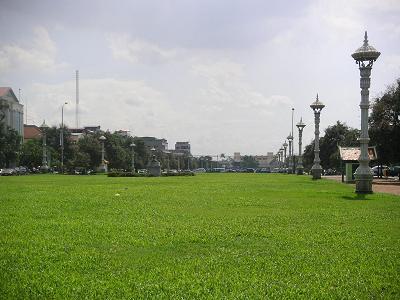
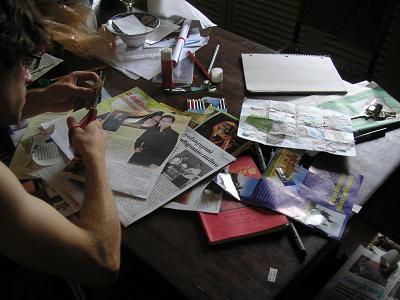
Today, Parker and I went to buy some Khmer newspapers and magazines in order to make collages with them. Making art is both calming and centering, and I feel more balanced and ready to live more carefully after doing so.

Tomorrow, I am going to visit Tep Mori's pin peat class in the Bassac community (more on this after I tomorrow). I actually briefly visited her on the first day I arrived, when we were on our way to visit Kong Nai, a blind chapei (Cambodian long-necked lute) player and improvisational singer. He's known as a sort of Cambodian bard, whose words and music express the popular sentiments on the people as well as his own personal flair. CLA is now working to produce an album of his music, part of an upcoming release of three albums of Cambodian music on the CLA label. It has been great to watch this project unfold, from meetings with the Thai embassy to secure a printing house in Bangkok to press the CD's to listening to different cuts of Cambodian musicians at the studio. As the project moves further along, I will probably get more involved to make sure everything runs smoothly. It's really exciting to be a part of this organization and I am hoping to learn more about how CLA and World Education work in Cambodia, as well as about the general model for NGO's in developing countries.
Monday, August 22, 2005
Wat Ummalom and Wat Phnom
It was a gorgeous, sunny day in the city today. I took a walk across town to visit several wats (Buddhist temple-monasteries). The first wat I visited, Wat Ummalom, is an historically important wat, seat of the patriarch of the Mahanikay sect. Today, however, is looked deserted, and there were very few monks around.
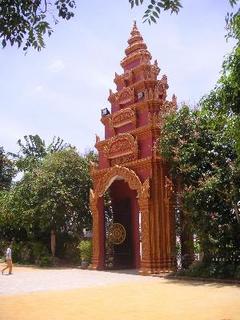 But the grounds and buildings of the wat are peaceful and beautiful.

The stone carvings were especially intricate and complex. The Khmer architectural style is unlike any I have ever seen, reminescent of some Indian Buddhist structures but completely different than the temples in Vietnam. And the symbolism in the art is a rich blend of Buddhist, Brahmanistic (Hindu), and indigeneous Khmer elements. At Wat Ummalom, there are also many stupas (conical Buddhist reliquaries), lingas (phallic representations of the Brahman deity Shiva), and scenes from the Reamker (the Khmer version of the Indian Ramayama epic).

And it was great to see the wat on such a gorgeous day, as it has been raining a lot lately. When it rains in Phnom Penh, it really rains hard, and the streets flood temporarily. Once the rain stops, however, the weather is very pleasant and cool. Because didn't rain today, by noon it was very hot outside.

After seeing Wat Ummalom, I took a walk over to Wat Phnom, which is situated on the only hill in the city. The wat is surrounded by a public park, for both humans and monkeys.

The wat also has many stupas, but is more typically Buddhist in style, and there are even several areas which are devoted to a more Chinese religious theme. The main temple is decorated with scenes from the Buddha's mythological past lives, known as the jataka stories, in which he sacrifices himself for the benefit of other living beings, especially animals. The most famous jataka in Cambodia is that of Prince Vessantara, which is the archetype of generousity in the popular Buddhist tradition. I had never been in a Theravada Buddhist temple before, and I was suprised to both the similarities and differences to Mahayana temples I have visited elsewhere. Wat Phnom does not appear to have many monks, and its function as a wat is mostly ceremonial.
I have a lot to learn about Buddhism in Cambodia, both in terms of understanding how animistic and Brahmanistic elements have been incorporated into the tradition and in terms of understanding how the terror of Democratic Kampuchea (the Khmer Rouge) broke the continuity of Buddhist teaching in Cambodia.
Sunday, August 21, 2005
CLA Studio
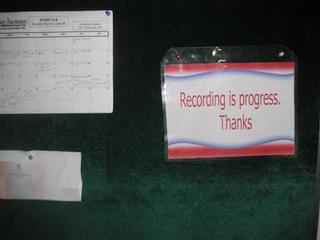
Parker, Beau and I went to visit the CLA Studio today near the Tuol Sleng Genocide Museum, of which I have read and seen a film about but have yet to visit. The studio is tucked away in the middle of an apartment building on a dirt backstreet in Phnom Penh. It has served to record many Cambodian traditional musicians and ensembles over the past couple years, including three new albums about to be released on the CLA label. The sign outside is amusing, though it speaks to the mission of CLA:
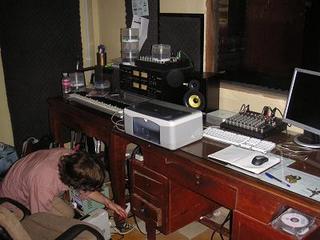
The inside of the studio is simple and functional, if a tad disorganized:
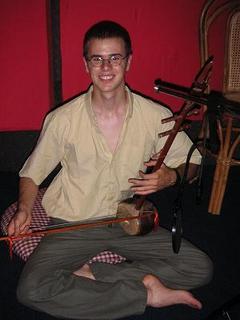
And there was a tro sau lying around that I tried to play. It's quite similar to the Chinese erhu, though with a slighter huskier and rougher tone:
While at the studio, I had the chance to listen to some of the recordings they had on file. The quality is excellent, although some recording glitches are still present. Beau burned a CD for me of as sampling of traditional genres. I'm still trying to figure out what kind of music I will pursue study in. At this point, I am particularly interested in smot, a vocal form of funeral music. It may sound morbid to you, but the music is haunting, soulful and meditative, and I am curious to learn more about it.

The inside of the studio is simple and functional, if a tad disorganized:

And there was a tro sau lying around that I tried to play. It's quite similar to the Chinese erhu, though with a slighter huskier and rougher tone:

While at the studio, I had the chance to listen to some of the recordings they had on file. The quality is excellent, although some recording glitches are still present. Beau burned a CD for me of as sampling of traditional genres. I'm still trying to figure out what kind of music I will pursue study in. At this point, I am particularly interested in smot, a vocal form of funeral music. It may sound morbid to you, but the music is haunting, soulful and meditative, and I am curious to learn more about it.
Saturday, August 20, 2005
Tropical Fruit and Syllabic Writing
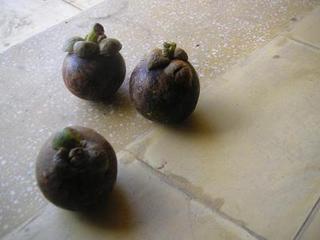
I am now feeling more settled in Phnom Penh. I went shopping for food, clothes and soap yesterday, which was an interesting experience. Parker and I went to open-air markets to buy fruit, Turkish-style bazaars to buy shirts and trousers, and a Western/Japanese supermarket to buy juice and cereal. The fruit here is delicious, especially this kind (mongkut, I think):
 I have also begun to study written Khmer (Cambodian) on my own, starting with consonants:
 and moving on to simple sentences:
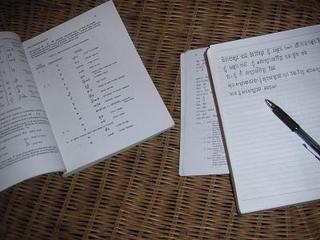 It's difficult, but very satisfying and I hope to find a language teacher soon.
 I have also begun to study written Khmer (Cambodian) on my own, starting with consonants:
 and moving on to simple sentences:
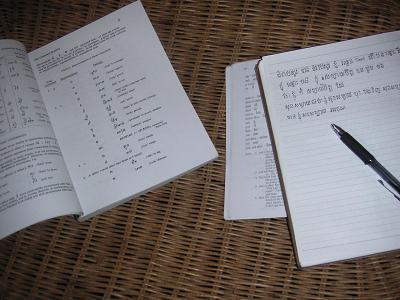 It's difficult, but very satisfying and I hope to find a language teacher soon.
Friday, August 19, 2005
Greetings from Phnom Penh!
It has been an exhilarating first couple of days in Cambodia. I have met lots of new and wonderful people, reconnected with friends, and been to a variety of places. The weather has been equally dramatic, alternating between sweltering heat and torrential rain. I haven't gotten sick yet, but i am somewhat prepared for that. I'm now living where I will likely be for the next month or so. It's an apartment on the 4th floor of a building across the street from a famous wat:
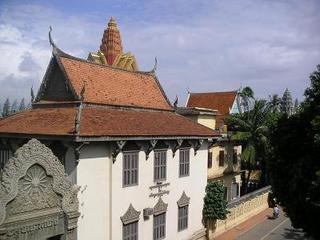 Saffron-robed monks can be seen on the sidewalke and the grounds of the temple.
Phnom Penh is a beautiful city, with wide, tree-;oned boulevards and few, if any, tall buildings. There are several rivers that cut through the city as well as several lakes. There are also many wats and other cultural landmarks in the vicinity. I definitely feel like I am a completely different country than Vietnam.
I am basically hanging out with Parker all day for the next few days as he helps orient me to the city, the culture and the work that Cambodian Living Arts (CLA) does. It has not yet dawned on me that I am staying here long-term, but I am slowly getting the hang of it.

 Saffron-robed monks can be seen on the sidewalke and the grounds of the temple.
Phnom Penh is a beautiful city, with wide, tree-;oned boulevards and few, if any, tall buildings. There are several rivers that cut through the city as well as several lakes. There are also many wats and other cultural landmarks in the vicinity. I definitely feel like I am a completely different country than Vietnam.
I am basically hanging out with Parker all day for the next few days as he helps orient me to the city, the culture and the work that Cambodian Living Arts (CLA) does. It has not yet dawned on me that I am staying here long-term, but I am slowly getting the hang of it.

Subscribe to:
Posts (Atom)