Just before I wrote this today, I was taking a stroll along the riverfront in Phnom Penh. Not many people were out, because the rain had just stopped, so I was quite suprised indeed when an elephant strolled by. Elephants, I had forgotten, are really quite large, and they're hard to miss. As I'm typing this now, there is a very small and very furry puppy yelping at my feet in the otherwise quiet internet cafe. This concludes my monthly animal update.
Yesterday Sambor and I, along with Sinath, a highly talented student on the khsae dieu, traveled to Takeo province to visit the master teacher (look gru) Sok Duch. One of older CLA masters, Sok Duch has a lively personality and a great laugh. He is not only master of the khsae dieu, but also is proficient and knowledgable about nearly all major Khmer instruments. And he not only teaches his students how to play the instruments and the traditional music associated with them, he also teaches them to build their own instruments. This was the most impressive part of visiting his class, to see students playing on instruments that are two hundred years old or on instruments that they had crafted themselves.
In fact, when we arrived, Sok Duch was literally putting the strings on a chapei dong veng that he had just completed in time for a student to use in the afternoon class, after working on it for about a month. Sok Duch actually did not spend much time with the class that afternoon; he mostly smoked and paced about the yard before sitting down to talk with me and Sambor. But his work with them was evident; the students had memorized 41 songs over the past year! And these are not short pieces of music, as most are well over ten minutes or more.
After visting the class and meeting the students for a while, Sambor and I went with Sok Duch to his house to talk further with him. I shared some of the Chinese erhu songs I knew on his tro sau, which he had built for his grandchildren. It was amazing to see the dedication and craftmanship he put into all the instruments he has made. In his house he kept a radio for the Sihanouk era (1950's and 1960's in Cambodia), which he used to use 70 batteries to run. When it wouldn't work, he would just replace a couple of them to fix it. It is hard for me to imagine living without electric power lines in the Cambodian countryside.
He also talked at length about his concern for the current situation in his country, especially the gangs and the corruption. Almost everyone I talk to, actually, is pretty upset with the corruption and the current government. I won't attempt to explain the political situation here, but is mostly stems from a prime minister who neither cares for his own people nor for the demands of other nations. Whatever people may complain about the government of the United States, it's hard to overstate how much more corrupt the situation is in Cambodia. The country is safe, but so many things that I take for granted as the duty of a government to do simply do not exist in Cambodia. For example, I have been trying to post this post on the blog for more than a day, but have been delayed by power outtages, very common in Cambodia. I'm not frustrated, but it is interesting to see exactly how much we have in the United States, how much is provided for us, and how little we actually, in fact, need.
Saturday, September 03, 2005

Thursday, September 01, 2005
Wat Lanka
Today, another beautiful day in Phnom Penh,

I went to visit Wat Lanka, a temple-monastery near the Indepedence Monument (above), that is home to about 200 monks and novices as well as a community of nuns. The main hall (vihear in Khmer) was closed when I came in the morning, so I quietly explored the rest of premises, consisting of many stupas (cheddai) and residences for the monks.
As I was walking out, a group of monks motioned me to come over and sit with them. We talked for a while in English and Khmer, about my stay in Cambodia and about Buddhism, until it was time for the monks to eat. I found out that one of the monks, Bhikkhu Saron, was a friend and former classmate of two of my friends at Silapak Khmer Amatak (Cambodian Living Arts), Rattanak and Seng. They were very suprised when I saw them later that day at the office that I knew their friend. I, too, was suprised and delighted to find even Phnom Penh to be a small world.
The monks informed me there would be vipassana meditation in the vihear at six in the evening, so I returned then to join a group of monks and laypeople in meditation practice. I am glad to have finally found a sangha (Buddhist community) in Cambodia where I feel supported and will learn more about this spiritual path.
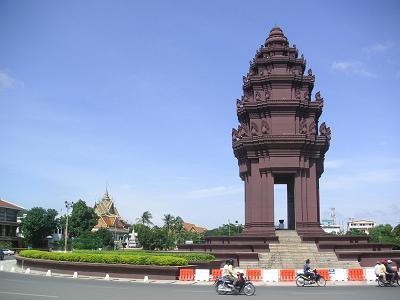
I went to visit Wat Lanka, a temple-monastery near the Indepedence Monument (above), that is home to about 200 monks and novices as well as a community of nuns. The main hall (vihear in Khmer) was closed when I came in the morning, so I quietly explored the rest of premises, consisting of many stupas (cheddai) and residences for the monks.
As I was walking out, a group of monks motioned me to come over and sit with them. We talked for a while in English and Khmer, about my stay in Cambodia and about Buddhism, until it was time for the monks to eat. I found out that one of the monks, Bhikkhu Saron, was a friend and former classmate of two of my friends at Silapak Khmer Amatak (Cambodian Living Arts), Rattanak and Seng. They were very suprised when I saw them later that day at the office that I knew their friend. I, too, was suprised and delighted to find even Phnom Penh to be a small world.
The monks informed me there would be vipassana meditation in the vihear at six in the evening, so I returned then to join a group of monks and laypeople in meditation practice. I am glad to have finally found a sangha (Buddhist community) in Cambodia where I feel supported and will learn more about this spiritual path.
Tuesday, August 30, 2005
High-Context, Low-Context
One of the most troubling things about being a foreigner in Cambodia is the respect that is afforded to one. Sometimes this is just simply respect that is put on as a way to attract business--and I understand and appreciate why this is important when only a few dollars a day is a liveable wage. Sometimes the respect comes out of genuine interest in what I'm doing here, for instance when I ask questions of the masters about their music. But the respect that is troubling to me is less tangible and harder to locate. I get respected just because I am a foreigner, and I have a certain place in the hierarchy of Cambodian society. Khmer society and language are bth can be described as "high-context", which means that how people interact with each other and what kind of language they use is highly dependent on the hierarchical relationship present. One of the difficult things about the Khmer language is that there different forms of almost every word to be used in differents contexts or with different people. For example, there is a special vocabulary to be used when talking to monks, and another set of words to be used when talking to royalty. There are also a baffling number of pronouns in frequent use that define the context of a particular conversation and the relationship between the affected parties. These traits are of course present in other neighboring Asian languages, but it seems that Khmer takes it to a higher degree.
Well, to get back to the question of respect, I notice that Khmer people use pretty respectful language around me, which defines the context of our relationship. I'm pretty used to our American "low-context" society, where we use about the same language with everybody and how we act is often based more on our individual disposition than the particular context we are in. So it is occasionally frustrating that it is nearly impossible to have "normal" social relationships with other Cambodians--that is, it is hard to be on equal terms with them. And because I am almost always in the dominant position of power, it can be hard for me realize the societal context that I'm in.
Of course, I have a lot of "power" in American society, but I was not made aware of it until coming here. And I can hardly complain about it, both because I want to respect the culture I'm living in and because I can appreciate what it's like to be on the other side of the hierarchy. Yet I realize that my American habits and inability to understand the "high-context" nature of Cambodian society will be an ever-present source of learning and frustration.
After I finished that paragraph, a young boy came up to me and asked me if he could shine my shoes. He explained that tomorrow he needed money to go to school. Whether or not this was true, it saddens me greatly to see children having to work or beg all hours of the day. But to express hope at the end of this post, I visited a gallery opening today of probably the first arts school in Cambodia (Reyum Arts School, www.reyum.org) that encourages creative expression through painting, drawing, and other media. Because schools are so overcrowded in Cambodia, kids can only go to either in the morning or the afternoon, and Reyum gives kids not only a safe environment so they don't have be unstructured and unsupervised on the street for much of the day, but also a chance to create and learn with their peers and prepare for a future vocation and a lifelong love of art. It makes me truly happy to see such positive action and the beautiful results of such action.
Well, to get back to the question of respect, I notice that Khmer people use pretty respectful language around me, which defines the context of our relationship. I'm pretty used to our American "low-context" society, where we use about the same language with everybody and how we act is often based more on our individual disposition than the particular context we are in. So it is occasionally frustrating that it is nearly impossible to have "normal" social relationships with other Cambodians--that is, it is hard to be on equal terms with them. And because I am almost always in the dominant position of power, it can be hard for me realize the societal context that I'm in.
Of course, I have a lot of "power" in American society, but I was not made aware of it until coming here. And I can hardly complain about it, both because I want to respect the culture I'm living in and because I can appreciate what it's like to be on the other side of the hierarchy. Yet I realize that my American habits and inability to understand the "high-context" nature of Cambodian society will be an ever-present source of learning and frustration.
After I finished that paragraph, a young boy came up to me and asked me if he could shine my shoes. He explained that tomorrow he needed money to go to school. Whether or not this was true, it saddens me greatly to see children having to work or beg all hours of the day. But to express hope at the end of this post, I visited a gallery opening today of probably the first arts school in Cambodia (Reyum Arts School, www.reyum.org) that encourages creative expression through painting, drawing, and other media. Because schools are so overcrowded in Cambodia, kids can only go to either in the morning or the afternoon, and Reyum gives kids not only a safe environment so they don't have be unstructured and unsupervised on the street for much of the day, but also a chance to create and learn with their peers and prepare for a future vocation and a lifelong love of art. It makes me truly happy to see such positive action and the beautiful results of such action.
Monday, August 29, 2005
A Breath of Fresh Air

Today I made my first trip to the Cambodian countryside to visit two smoat masters in Konpong Speu province. Smoat is a very soulful style of singing, almost chant-like, that is used in Buddhist funeral ceremonies. The songs are often poetic retelling of Buddhist stories, and usually are morally or spiritually didactic. A common subject of smoat music is jataka, Buddhist stories, either canonical or apocryphal and unique to Khmer culture, that recount the Buddha's previous lives before he attained enlightenment. There are over 547 jataka in the Pali Canon, and many more have circulated in Cambodia, and most of them recount the lives of virtuous animals and have a very playful character, although they generally end with the main character dying. The most commonly heard are the last ten lives of the Buddha, and even more so the Buddha's final life before he was born as the Indian prince Siddartha Gautama. In his next-to-last rebirth, the Buddha took the form of Prince Vessantara, who represents the perfection of generousity by giving away his possesions, his land, his country, his wife, his children, etc., until he literally gives away his heart. It's a remarkable little story with lots of delicious details, including a greedy old man who eats too much and, just like you or I would in a similar situation, explodes. But getting back to the music at hand, smoat is particularly beautiful style of singing, with long phrases and characteristic ornamentation.
Sambor and I drove for about an hour and a half to reach the masters, after making it through some muddy roads and several detours. The countryside, filled with rice paddies of a brilliant green color and tall, slender palm trees, is beautiful. It was so refreshing to be out of the city, where the pollution makes it difficult to breathe, and be closer to nature. The poverty is also more apparent, but in a different, and less jarring, way than in the city. We finally arrived at where the smoat class was being held, at a house, on stilts to avert flood damage, in a small village. We were greeted by one of the masters and some of the students, who led us up the stairs and into the house, where there were about twenty students sitting on the floor. After traditional greetings, we all took a seat and introduced each other.
The two masters, one man and one woman, have very fine voices and it was great to meet them in person after listening to their recordings. The man began his study of smoat when he was fifteen years old and a novice monk at a Buddhist wat. He is now considered one of the foremost masters of the art. The woman was a bit younger, and is believed to suffer from hysterical blindness, a psycho-somatic illness that afflicts a certain number of older Cambodian women who were forced to watch the execution of their husbands during the Khmer Rouge era. They are both very kind teachers, and I feel fortunate to have had the chance to meet them.
We all talked for a couple hours about smoat, and I learned a lot from the exchange. Several of the students, who had remarkable voices, also shared some of their skills. They were interested in opera, but through some confusion in translation, I thought they meant throatsinging, so I shared some of that before I sang some of the very limited German opera I know. All things considered, it did feel a little weird for me to be the only medium through which they had ever heard Tuvan throatsinging or German arias. But the sense of exchange was powerful for both me and them, and they repeated that I would be very welcome to stay in their community, perhaps at the local wat, and study smoat. I don't know if will decide to live in Konpong Speu and study this wonderful form of music, but I am very happy to have this experience and to meet such welcoming people.
Sambor and I then went to visit the local wat, which sits on top of the only hill for miles. As such, it has a gorgeous view of the surrounding countryside. After two weeks in crowded, congested cities, the pure air and the peacefulness were a welcome relief. The wat was very simple, but the trees and majestic silence were duly inspiring. I hope very mcuh that I will return. Here's a picture of the view from the top:

Below is another image of the view:

After I captured this image, it realized that the view really reminded me of a series of paintings by Cezanne of Mont St. Victoire.

Sunday, August 28, 2005
New and Depressing Things
Each day I learn new and wonderful things about Cambodia and its rich culture, but I also learn new and depressing things about the state of this poor Southeast Asian nation. I though I had seen poverty before, whether through living in Chinatown in San Francisco or through visiting parts of other countries, and indeed in all these places there is a great deal of poverty, and the people in these places struggle each day to put food on the table--even they even have a table, a home, or a family. But the poverty in Cambodia is much more acute, and the signs of suffering are much more visible and apparent. I don't mean to say that the people are necessarily less happy or content because of this, but I do mean to say that the suffering here is very real and cannot be ignored or mitigated by looking away.
There are many victims of land mines in Phnom Penh--those that have lost limbs, mobility, livelihood and sometimes even half their face from the perennial results of war from decades earlier. And their are just as many who are handicapped or horrifically disfigured from illnesses and accidents unrelated to war, but because of the medical standards of the country, they are unable to find meaningful or affordable treatment. Young men arrive from the countryside and find no work in the city. Mothers send their children out onto the street with their babies to beg for money. And street children who truly have no home struggle to survive by selling a few newspapers or bootlegged books.
Moreover, even their own government is trying to uproot the poor from their homes and their livelihoods. The Tonle Bassac community where I visited four masters and their music classes is one example. The community is named because of the theater that used to exist there, which was likely burned down by the CPP (Cambodian People's People, the current ruling party of Cambodia, headed by Prime Minister Hun Sen, who is widely disliked among the Khmer for his authoritarian rule, the corruption of his administration, and his disinterest in helping Cambodians who are not rich businessmen). The community lives in fear of eviction because developers and the government officials who will profit from such development want the slum converted in a shopping mall.
For me, this is the kind of story that I read about happening but could never really understand what was going on. But now that I know the people that it affects so deeply, and have witnessed the strength of their resolve in creating a revival of the arts in their community, the situation pains me much more. Today, UN officials visited the community and interviewed Ki Mum and her students, whom I had visited just days before. Through the interviews it became apparent that the government had been threatening the residents of the Tonle Bassac to move elsewhere or their community would be burned down or bulldozed without advance notice. And the threats are not empty because the community has been a victim of arson by the government before. Furthermore, the government is now threatening legal action against the members of the community because it alledges that the 800 fingerprints the residents collected to certify the joint complaint they filed were fake. This is truly a deplorable situation, and is certainly one of the most outrageous examples of economic cruelty I have ever heard of.
All this makes me wonder why I choose to just study music and Buddhism during my time here. Shouldn't I be working to improve the material conditions of the people in Cambodia? Well, shouldn't you? If you have the financial means, there are many NGO's that are doing excellent work in health care, human rights, AIDS, women's rights and other areas in Phnom Penh and I am sure they would appreciate your support. And not just in Cambodia--a comparatively small sum of American money goes a long way in developing countries, whether it be to buy mosquito nets, to fund education about sexually transmitted diseases, or to help bring justice to issues of human rights. I, too, hope that I can find a way to meaningfully contribute to the material well-being of Cambodians.
However, my main intention in my time here is to look at Cambodia not as a country of problems, but as one whose rich musical, spiritual and artistic traditions have a great deal to teach the world. In a post-genocide society, restoring faith in one's culture, religion and traditions goes a long way toward promoting emotional and spiritual health. And while I know my impact me indeed be small, I sincerely hope that I can always remember to make this my intention during my time here. I love this country, its people, its language, its spiritual values and its arts traditions, and I want to make sure these treasures are accessible to the Cambodian people and may be a point of pride to the world at large.
There are many victims of land mines in Phnom Penh--those that have lost limbs, mobility, livelihood and sometimes even half their face from the perennial results of war from decades earlier. And their are just as many who are handicapped or horrifically disfigured from illnesses and accidents unrelated to war, but because of the medical standards of the country, they are unable to find meaningful or affordable treatment. Young men arrive from the countryside and find no work in the city. Mothers send their children out onto the street with their babies to beg for money. And street children who truly have no home struggle to survive by selling a few newspapers or bootlegged books.
Moreover, even their own government is trying to uproot the poor from their homes and their livelihoods. The Tonle Bassac community where I visited four masters and their music classes is one example. The community is named because of the theater that used to exist there, which was likely burned down by the CPP (Cambodian People's People, the current ruling party of Cambodia, headed by Prime Minister Hun Sen, who is widely disliked among the Khmer for his authoritarian rule, the corruption of his administration, and his disinterest in helping Cambodians who are not rich businessmen). The community lives in fear of eviction because developers and the government officials who will profit from such development want the slum converted in a shopping mall.
For me, this is the kind of story that I read about happening but could never really understand what was going on. But now that I know the people that it affects so deeply, and have witnessed the strength of their resolve in creating a revival of the arts in their community, the situation pains me much more. Today, UN officials visited the community and interviewed Ki Mum and her students, whom I had visited just days before. Through the interviews it became apparent that the government had been threatening the residents of the Tonle Bassac to move elsewhere or their community would be burned down or bulldozed without advance notice. And the threats are not empty because the community has been a victim of arson by the government before. Furthermore, the government is now threatening legal action against the members of the community because it alledges that the 800 fingerprints the residents collected to certify the joint complaint they filed were fake. This is truly a deplorable situation, and is certainly one of the most outrageous examples of economic cruelty I have ever heard of.
All this makes me wonder why I choose to just study music and Buddhism during my time here. Shouldn't I be working to improve the material conditions of the people in Cambodia? Well, shouldn't you? If you have the financial means, there are many NGO's that are doing excellent work in health care, human rights, AIDS, women's rights and other areas in Phnom Penh and I am sure they would appreciate your support. And not just in Cambodia--a comparatively small sum of American money goes a long way in developing countries, whether it be to buy mosquito nets, to fund education about sexually transmitted diseases, or to help bring justice to issues of human rights. I, too, hope that I can find a way to meaningfully contribute to the material well-being of Cambodians.
However, my main intention in my time here is to look at Cambodia not as a country of problems, but as one whose rich musical, spiritual and artistic traditions have a great deal to teach the world. In a post-genocide society, restoring faith in one's culture, religion and traditions goes a long way toward promoting emotional and spiritual health. And while I know my impact me indeed be small, I sincerely hope that I can always remember to make this my intention during my time here. I love this country, its people, its language, its spiritual values and its arts traditions, and I want to make sure these treasures are accessible to the Cambodian people and may be a point of pride to the world at large.
Saturday, August 27, 2005
One-string Wonder

I've been teaching myself to play khsae dieu (see above), a one-string Khmer instrument with a particularly delicate and quiet tone. The instrument was once heard often in the countryside in the evenings, when elderly men would quietly play the instrument before retiring to bed. Although it only has one string, the instrument can produce complete scales through the use of overtones and pitch-bending. The picture below shows me attempting to play it.
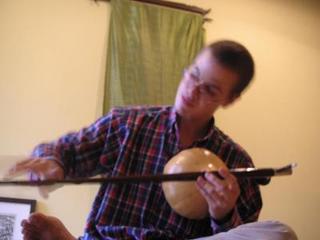
The left hand stops the string against the wooden shaft to generate different pitches, while the ring finger of the right hand plucks the string. However, many more pitches can be generated through two special techniques in the right hand. The first is simply to push down on the shaft with the right little finger, which increases the tension on the string and thus raises the pitch as much as a fourth. The other technique is to gently touch the right forefinger to the string while plucking as usual with the ring finger. If done at the right places along the string, a particular overtone is isolated (the octave, the fifth, the second octave, the third, the fifth, etc.), allowing for a full range of three octaves and all the tones in between. When the overtone is isolated in this manner, the khsae dieu has a very pure and beautiful tone, unlike almost any other string instrument. The only other similar instrument I've heard is the Vietnamese dan bau, another one-string instrument that uses overtone isolation.
The khsae dieu is a very enjoyable instrument to play, one that is uniquely Khmer in character. The Ven. Pin Sem, abbot of Wat Bo in Siem Reap (near the Angkor Wat temple complex, northwestern Cambodia), pleaded succesfully with one of the few remaining masters of this instrument to have it taught to the wat to local students. It now looks like there are enough students to pass the instrument and the repertoire associated with it down to the next generation.
I also had my first Khmer lesson today with Rith, a sharp, enthusiastic fellow. His teaching style seems to work well, and today we acted out a scene in a restaurant to practice vocabulary and sentence building. And the lesson has already paid off, because for dinner today I went to a local Khmer eatery (not really a restaurant, more a home that turns into a noodle-serving joint in the evening) and ordered in Khmer. I am planning to go to the local market tomorrow to buy fruits, vegetables, and tofu so that I can cook for myself. I probably won't be saving money this way, as my dinner today was about 63 cents, but it will be more enjoyable and I need to improve my cooking skills.
Friday, August 26, 2005
Settled In
Parker departed to the States yesterday, and Beau will also be leaving in the next five days, so I'm now trying to figure things out on my own. I beginning to know the city well enough to get around, and I'm also becoming more adept at finding out which Khmer food is meat- and dairy-free. I now feel settled in the apartment where I will be staying for the next month--I'll probably move into a home-stay with a Cambodian family after that. Below is a photo of what the kitchen looks like (it's way more than adequate!).

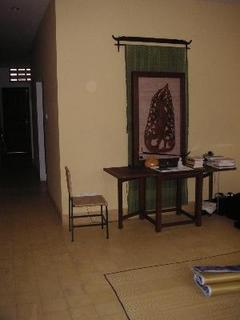
The room where I'm sleeping looks something like this:
I am continuing to practice Khmer on my own, although I am meeting with a teacher tomorrow to arrange some lessons. I am finding it much easier to learn a language in the country where it is spoken, because it can be used all the time. Below is some writing I've been working on (colors inverted just for fun).

On Monday, I plan to make my first trip out of the city to visit the smot masters in Takeo province. In the meantime, I will be helping as much as I can with the CD project, which is a great learning experience for me. It is only now dawning on me that I am going to be spending such a long time in this country, which is both daunting and comforting. I hope that over the next month I will have a much better idea of what I will be focusing on this year.
Thursday, August 25, 2005
A Successful Session

I spent most of the day yesterday at the CLA recording studio, observing a very successful recording session. My official duty was to take pictures forthe liner notes, but the flash drained the batttery after about five pictures. So I mostly was able to listen to some amazing music, watch how Cambodian musicians work, and learn more about the process of recording. The sessions were remarkably problem-free. Apart from some drilling and other construction work happening next door, there was little to worry about in terms of sonic interference. In addition, there were only a few technical difficulties with the recording equipment. But most of all, the musicians, fifteen in all, played almost flawlessly throughout the day, and only a few takes had to be restarted.

The music and musicians had been organized by the master teacher and professor Yun Theara, a enormously talented multi-instrumentalist who has emerged as one of the leading traditional musicians in Cambodia today. Beau, who was supervising the recording process and training the Cambodian studio engineers in the art of microphone placement and levels, was very happy with the results. Although I know only a little about Cambodian music, what I did hear in the studio was some of the best-recorded and well-performed Cambodian music I have ever heard. It's great to see Cambodia's master musicians recording and playing music together at such high levels again.
As I am writing this at an internet cafe in Phnom Penh, I am sitting between two monks who are chatting online or writing emails. I have been reading about the state of Cambodian Buddhism in the post-Democratic Kampuchea (Khmer Rouge) era. I am curious to learn more about the state of the sangha, the vision of the leadership (if indeed they have a vision), and the way contemporary Cambodian Buddhism relates to the arts in the country (if there is indeed any relation). There is always lots to learn!
Subscribe to:
Posts (Atom)