Reflections on Cambodia, Buddhism and Music

Saturday, October 14, 2006

Digital Manuscripts


I know it has been a long time since I have updated this blog, but as I settle in more at Stanford and begin to work on my Cambodia projects again, hopefully I will be posting here more often.

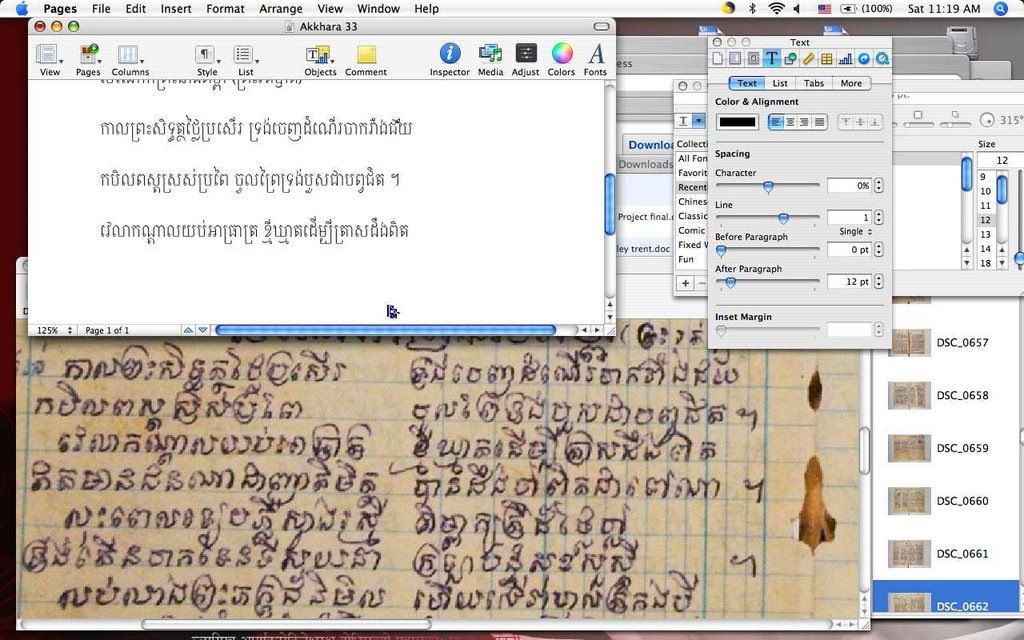
A current project I am working on is typing up various Dharma song manuscripts I came across during my stay in Cambodia. Several of them, such as this wonderful "smot journal" lent to me by Suon Bunrith of Amrita Performing Arts (www.amritaperformingarts.org), I was able to capture in the form of digital images. I am now in the process of typing some of the rarer songs into the computer with the Khmer Unicode font, which is a significant improvement over earlier imput methods.

Monday, September 25, 2006

Return

Now that I have returned to California after 13 some months abroad in Cambodia, it is a bit intimidating to write about my experiences there. I suppose it is only myself who would be capable of such intimidation, but nevertheless I remain in awe of the sheer amount of territory I have observed and experienced without putting it into words. Back in the comfort of life at Stanford, glorious September weather and the eerie security from hazards, Cambodia suddenly seems far away, connected to this realm only through memory, books, sounds, images, and the occasional person I meet who has roots there.
Then there is the issue of the validity of the work I was doing there. The world of scholarship is one that it not entirely foreign to me, but it is certainly one that I have never had a voice in. And now that I do have the knowledge and the experience to make a contribution, will my voice be a valid one? This is where, perhaps, I am looking for a mentor, to search for real meaning in my work and rediscover what I innately know to be the real joy of writing.

But where to start? Cambodia unfolds like waterfall in my memory-- slow at first, then falling in separate streams, each of great intensity, before rushing on into the roaring stream below. The lines between scholarship and memory and also unclear. To what extant can I authoritatively write about my experience? Then again, I suppose, to what extent can I really write about books and the experiences of others. I somehow sense that there will be a voice that emerges from all this, from the growing pains of nascent adulthood, the trials of moral decisions, the quest for a spiritual life, and the struggle to “save” traditional Khmer culture. It’s a journey all right, but who is it really for? I may understand a little bit of my own place in it, at least in terms of my own journey. But how will I contribute to the journeys of others, the journeys of Khmer students, monks and musicians, of masters and apprentices?
I have only begun to unearth the mound of material I have collected, which looms above my desk and fills my consciousness with the thirst of discovery. And for so long my writing has stalled, and I knew inside that I just needed to let this writing come out, without judgment or pre-planned outlines. It feels wonderful, really quite wonderful, to be writing again.

Yesterday I went to Nagara Dhamma temple in SF for their Phchum Ben ceremony, which above all struck me as an American affair. Unlike my previous visit, in which I mostly listened to a bhikkhu for Surin talk in his heavily-accented Khmer, I barely said a word to the monks this time around. The same familiar chants were a always a deep joy to partake in, and I felt a genuine spiritual atmosphere that I had not really sensed in Cambodia. In particular, it felt much more tender and genuine that Wat Campuh k’aek, and the community feeling was much stronger than at Wat Bo. The Thai chanting in Pali was beautiful and unforgettable in a way, and it carried the same kind of resonance of the chanting of the Tibetan Gyuto monks. I also felt like I was building my first connections in the Khmer American community. Obviously, but perhaps surprising as well, was the reaction to the attendees when I spoke Khmer, which was basically the same reaction as in Cambodia. Almost every conversation I had was bilingual, which made for a rich interplay of language and idiom, and it was especially refreshing to be speaking the tongue that had become so natural to me when I was in Cambodia. A chance encounter with a Christian monk in beautiful purple robes who has close connections to Buddhist monks in Cambodia, Father Nazarene, seems to be a fortunate opportunity to continue to connect with the Khmer Buddhist community.

But what I am really here to write about is my research on the Cambodian Dharma song tradition, one that continues to speak to me and pervade my inner life. I continue to hear the strains of “yo vo ananda” and “thvay phka” in my head as I walk around campus, and I often wonder if these songs aren’t the most beautiful thing on earth. The Dharma that they proclaim is slowly ripening as I understand them more and more.

Tuesday, August 01, 2006

In the studio

I am currently managing the recording of my smot teachers in the Cambodian Living Arts studio in order to create a complete archive of their knowledge for others to study from and to preserve high-quality documentation of their vocal techinque. Here are few images from the sessions.


My teacher, Assistant Master Keot Ran, smiling with me.


Keot Ran with two of my fellow smot students, Srei Peu and Srei On, who also participated in the recording.


Master Prum Ut preparing to record.


Sarin and Samath, who recorded and engineered the sessions, helping my master adjust the microphone.

Saturday, July 15, 2006

Reflection on lay life

I have now been out of robes for more than five days, and the transition is going smoothly for the most part. I have not given much time to reflect on how radically different my life is now. In some ways, it feels as if the five months I spent as a monk simply disappeared, and I'm suddenly back where I was five months earlier. This is true, in a certain sense, as I am returning to where I left off in the research work, but the sense of disconnect between my life as a monk and as a layman is hard to get my head around. My studies of Khmer Buddhism actually made much more progress during the time I was a monk than they did in the months preceeding my ordination. In the little time that remains, my increased knowledge and experience allows me to accomplish a great deal more than before, but it is just as easy to get too busy in research and other work that I forget to actually slow down and look carefully at things.

When I was a monk at Wat Bo, the environment was full of noise and distractions, and it was hard to find a quiet space, both inside (in my heart/mind) and outside (within the temple grounds). Eventually, I chose to live alone inside of the old main temple, which was the most quiet place I could find, and through carefully increasing my effort I was doing sitting or walking meditation almost the entire day (15-16 hours), with a couple of hours for begging, eating and washing up and four hours for sleeping. It was not an easy time for me, but slowly my mind began to settle out and I could see its contents and nature a little bit more clearly. I also remember being filled with radiant joy during this time, a feeling that I had not experienced for long periods of time before.

But little by little, I let distractions creep in and my practice began to weaken. In May, my teacher went to America and I decided that it would be a good opportunity to switch temples. Yet it took another month and a half at the new temple to settle into an intensive meditation practice again. As a layperson now, the distractions are infinite in variety, and it takes much more effort to settle the mind. I recognize, however, that slowing down and looking carefully at each moment is a source of great peace and happiness for me, and it allows so many for opportunities to be truly useful to others. But I have found that training this mind and heart, especially during transitions in our lives, is not easy for me, and that I need to learn to be patient on this path.

Monday, July 03, 2006

Return to Phnom Penh

Dear friends,

I have now officially left the monkhood and am back at work at Cambodian Living Arts (a non-governmental organazation (NGO) that supports many Khmer arts projects, including studio and field recording, music, theatre and dance classes for children and young adults, and commissioning new work from Cambodian artists) and my own research work. It is an unusual transition to be wearing pants, shoes and a shirt again, but I have succeeded in keeping my clothes on.

I suddenly have found myself very busy again, running between meetings and enthusiastically searching for books and manuscripts. It is somewhat of a cliché that everything takes longer to accomplish in Cambodia, as snafus of all kinds are a daily affair. Nevertheless, each day has endless suprises too. I may go to bookstore looking for a certain book and get into a 2-hour conversation with the manager about Khmer arts in Vietnam or about the subtleties of Cambodian Buddhist traditions. In the end, keeping my eyes and ears open is the best way to learn. No matter how much I study, there is so much knowledge about Cambodian culture that I am only scratching the surface of.

Below is a brief summary I wrote on smot chanting. I hope it clarifies some of what I write about on this blog.


Smot Chanting

The word smot literally refers to a style of chanting Khmer poetry or Pali Buddhist scriptures that has parlicularly long and flowing melodies. For Khmer poetry, there are around 60 melodies used for recitation today, with many regional variations, although some of the melodies are much shorter and less complicated and are more often called me sot. The shorter melodies are generally used for narration and happier passages, and the longer melodies are more often associated with serious texts or lamentations. The melodies used for chanting Pali, as distinct from those used for Khmer poetry, are generally less-known, longer and more complex; at least 10 melodies are still used today, and regional variations are much more numerous.

The smot chanting of Khmer poetry is used both in the performance of short poems as well as longer pieces of literature (such the Reamké or the Jataka stories of the Buddha's former births) and in Buddhist ceremonies. When smot chanting is used to chant secular poems, a tro or flute may accompany the singer. The large shadow-puppet performance of the Reamké includes narration in the smot chanting style, generally in between musical selections by the pin peat orchestra. Other traditional performance style may include smot as well.

Smot also is used in more religious contexts. Indeed, the popular understanding of the word smot associates it most directly with Buddhist funeral ceremonies, but it is also used in a wide range of other rituals, such as inviting monks to preach, dedicating a new Buddha image, offering flowers to the Buddha, or when a person is preparing for death. For these occasions either monks or laypeople may chant Khmer texts, generally poems translated from the Pali Buddhist scriptures, or Pali texts, although the use of the latter is much rarer today and generally more reserved for the monks.

The long and flowing melodies of smot are considered to be quite melacholy, whether or not the text itself is actually sad. Thus smot, especially in the context of funeral ceremonies, has the power to bring tears to many people's eyes. It should be noted, however, that the purpose of smot in Buddhist funerals is not to cause people to cry or become fearful of ghosts, but rather to "shock" (in Pali, samvega) the listeners into realizing the impermanence of life and renew their efforts to do good, avoid evil and purify their minds in accordance with the teachings of Buddhism.

Smot chanting is known to be one of the most difficult vocal styles because its technique requires precise control of the vocal cords to produce the correct sound. The style is also known for its gentle vibrato, subtle falsetto breaks, and the large breath support required to complete the long phrases typical of smot melodies. The melodies themselves, while frightening to some people, are widely-known for their beauty and the powerful atmosphere they can create. Today, there are few living masters of smot chanting, either in sacred or secular realms, and most who want to learn must learn from cassette tapes.
Saturday, July 01, 2006