Reflections on Cambodia, Buddhism and Music

Tuesday, September 27, 2005

More pictures of Wat Ang Krapeu


The "lake" in the background is actually flooded farmland (rice fields). Many of the provinces surrounding Phnom Penh receive this kind of flooding during the monsoon season.

Rith with a crocodile that actually floats in high flood waters. Behind is the small temple where the gru boramey lives.

Sunday, September 25, 2005

Wat Ang Krapeu

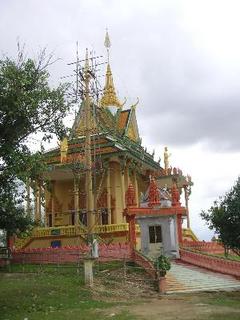
Today Rith, my language teacher, and I went visit Wat Ang Krapeu, a popular pagoda during the Buddhist holiday of Pchum Ben. Together with Rith's extended family and friends (about 15 people), we traveled for about hour outside of Phnom Penh to visit this wat, which in the rainy monsoon season is mostly surrounded by water stretching out to the distant hills. The name of Wat Ang Krapeu refers to the crocodiles (krapeu is Khmer for crocodile) that used to live in the area.


Pchum Ben is one of two major Buddhist festivals each year in Cambodia, the other being Khmer New Year. Pchum Ben, celebrated in different forms and with different names throughout Asia, is the official end of the three-month rainy season monastic retreat, a tradition begun by the Buddha himself 2500 years ago, during which monks are expected to study more intensely and follow a more strict discipline in their home wat. Pchum Ben, celebrated over a period of fifteen days, actually has little to do with the monastic retreat. The fifteen days begin with Autumn Moon Festival, which is more known as a Chinese holiday and even in Cambodia it is traditional to eat Chinese moon cakes.

During Pchum Ben, many Cambodian Buddhists believe that the spirits (hungry ghosts or hell-beings) of their ancestors, especially those who have accumulated negative karma, come out during the early morning hours, usually from 3:00 AM until sunrise. So at 3:00 AM all across Cambodia, the wats are filled with people. Most buy or have made for themselves plates of rice rolled into small balls, which are used to feed the ghosts and hell-beings which come out during the night. The believers, with candles in hand, then circumambulate (very slowly, because there are often lots and lots of people) the vihear (main temple building of the wat) while simultaneously throwing the rice balls towards the walls of the temple. In case you're wondering, this also happens to be a good deal of fun; in fact, I have rarely seen people having so much fun at 3:00 AM.

Pchum Ben is also much more than these early morning rituals. During the daytime, many more lay Buddhists go to the wats during the day to listen to Buddhist teachings, pray, or offer food to the monks. Because Pchum Ben is generally more about honoring one's ancestors than practicing Buddhism, the aim of all these activities is to transfer karmic merit to one's deceased relatives. Women tend to dress up in a traditional Khmer dress and white top when they visit the wat during Pchum Ben (as dressed up as they would be for a wedding or another formal occasion), which is interpreted as a gesture of respect. The wats themselves also have a great deal more decorations during this time.
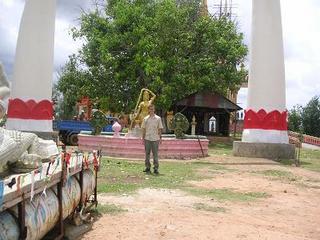

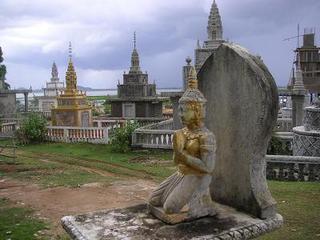
Wat Ang Krapeu, like nearly all wats in Cambodia, was rebuilt after the Khmer Rouge destruction, so it is architectually in the same mould of most other wats. However, the large concrete elephant tusks shown above were new for me, and those who I talked to about them didn't seem to understand them either.
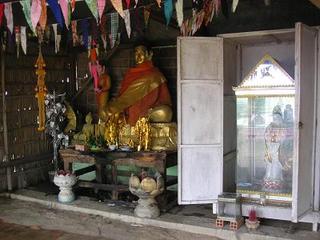


Another interesting element to the wat is the prescence of this small Chinese altar, unusually for a Khmer wat, in a small temple behind the main vihear. Although these pictures were all taken after most of the people left to go home, Wat Ang Krapeu was indeed very crowded today. Some of the people were making ritual minature sand mountains on the grounds of the wat, others were offering and preparing food for the sangha, while others were seeking the advice of a monk in the vihear. A festive, though respectful, atmosphere pervaded the wat, and the well-dressed lay believers, young and old alike, were engaging in just about the full range of Khmer religious activities.

Rith's family and I went to a small temple on the edge of wat to visit a tsun ji, the closest equilvalent of a nun in the Khmer tradition, who was also a medium (gru boramey). Mediums and trance states are outside the realm of Buddhism and are specifically prohibited in the vinaya, but their popularity in Cambodia is widespread. In short, a gru boramey is a medium for any number of spirits, usually those of kings or accomplised acsetics, who manifest in the gru boramey when he or she calls the spirit to enter their body. When the spirit in present in them, they manifest the characterestics, including the preferred language, of the spirit.

The tsun ji we visited, a relative of Rith's, is a gru boramey who manifests the spirit of Jayavarman VII, a famous Angkorian king. Rith's mother was looking for advice, so she sought out this medium to for help. After presenting the medium with some symbolic gifts, she (the medium) began to make incantations in Sanskrit to call the spirit to enter her body. After a period of more chanting and ritual, the spirit entered her (apparently) and her personality changed completely. She also began to speak in Thai, a language that the gru boramey doesn't know when the spirit is not inhabiting her body. Then Rith's mother, Rith, the spirit inhabiting the medium, and a monk the spirit was talking to (this monk we couldn't see or hear, but we could tell the spirit was talking to a monk), began to have a lively conversation. For the most part I could follow what was going on, as Rith would occasionally translate and clarify things for me, except when the spirit began to speak in Thai!

Gru boramey have a complex relationship with mainstream Theravada Buddhism, because although they are generally prohibited from practicing in wats, many still do and even some monks are known to be gru boramey. Gru boramey are also generally dedicated practioners of the Buddhist precepts and are supportive of the sangha, and nearly all of them give everything that people offer to them directly to the wat. Taking this into account, it is hard to say how they fit into the context of a wider Buddhist tradition, if they do at all, but it is safe to say that Cambodia is the only country where gru boramey and Theravada Buddhism co-exist to such a great extent.

After the spirit left the gru boramey, we were all able to have a nice conversation and lunch together in her small home. A while later, I was by chance able to meet some young orphans at the wat and hear them perform some pin peat music that they had been studying. I am continually amazed by these kinds of experiences that I am having in Cambodia, and while some of them are certainly more foriegn to me than others, I am very grateful for the chance to have them.

Saturday, September 24, 2005

The First Month

The first month has passed before my eyes very quickly, and while I now have a pretty clear picture of what I will be doing this year, I think it's important for me to reflect on the broad and amazing experience I've had so far. This month was my chance to get oriented--oriented to the culture, the music, the religion, and the language. In each of these areas I have learned a great deal and, perhaps more importantly, I have had many experiences, both positive and negative, that have supported what I have read or been taught.

Starting with the language, perhaps the most tangible of the four areas, I now feel well-aquainted with basic conversation skills, have devoleped more of an ear for understanding Khmer, and have learned enough to read and write as much or more than I can speak. Moreover, I now realize how much work it is going to take to make further strides in my language abilities. I am currently studying with my teacher for four hours a day and I also study about that much more on my own, and what I enjoy most about studying Khmer is that it never feels like a burden or a task--language learning, especially when it can be applied in almost any situation I encounter outside my flat, is deeply satisfying to me.

My plans for the coming months are as follows. I will stay in Phnom Penh for about another month, focusing on studying the language, so that by the end of October, I will be ready, or as ready as possible, to live in the countryside without a translator. I plan to take up residence in Kompong Speu province--pending the availability of a place to live--in order to study smoat chanting there. The chanting master also spends two weeks per month as an achar (lay ritual specialist) at a wat on the outskirts of Phnom Penh, so my living arrangement may also take this into account. After about 3 1/2 or 4 months of smoat study, towards the end of February I plan on preparing for ordination into the novitiate, most likely under Ven. Pin Sem at Wat Rajabo, Siem Reap, where I plan on spending the rest of my time in Cambodia, most likely six months, until September 2006.

This brings me to the second of the four areas, religion. From the beginning of my interest in coming to Cambodia, I have been most focused on studying the interrelationship between Khmer music and the religious practices of the Khmer people, for the most part dominated by Theravada Buddhism. While in Phnom Penh, I am doing what I can to observe and participate in the life of the wats. Concurrently, I am reading as much as I can on Khmer religion to be able to put into a larger context what I observe from day to day. Again, my study constantly reminds of how much I have yet to learn.

I have had a great many enriching experiences with the third area, music. Whether it has been visiting the masters and their students in the Tonle Bassac community, taking trips out to the provinces to see how music is taught and performed there, or taking up study on the tro sau with master and professor Yun Theara in Phnom Penh, I have learned about and experienced a broad slice of traditional music in Cambodia. There has been little that makes me happier than seeing the young people in the classes show such talent and dedication in their study of traditional music--it is a joy to behold and makes me feel a great deal of respect for the masters and the way music is taught and passed on in Khmer culture. Each class I visited affected me in a different way, and I still am sometimes without words to describe how moved I am to see a culture and an ancient tradition blossoming again.

The fourth and final area, culture, is the least tangible to me and the area where I sometimes feel the most lost. Culture is deeply embedded in history, and I am doing what I can study and observe how Cambodia's past guides the lives of people today, but in general I realize that learning about a culture is not something that really can be quantified. Cultures enter our bodies more than our minds; we adapt to living in another culture below the level of intellectualization, but rather at the level of intuition. And in my experience, learning about another culture turns out to be much more about learning about myself and my own attitudes and prejudices than those of others. I am not trying to rush this area of learning, but rather let it seep through me and change me from the inside--this is the only I way I know to learn. And while I laugh as I realize that it will be hard for me for to go back my country and not address everyone by their kinship relation or not be able to expect a backdrop of Theravada Buddhism as the norm, I know that learning about Khmer culture has been a wonderful journey so far and I will continue to meet more joys and difficulties in the future. To be sure, the same could be said of the three other areas of language, religion and music in my first month: what I have learned has energizied and inspired me to just let myself go deeper and open my eyes wider, so that journey of these coming months may continue to be fruitful.

Wednesday, September 21, 2005

Centre Culturel Français


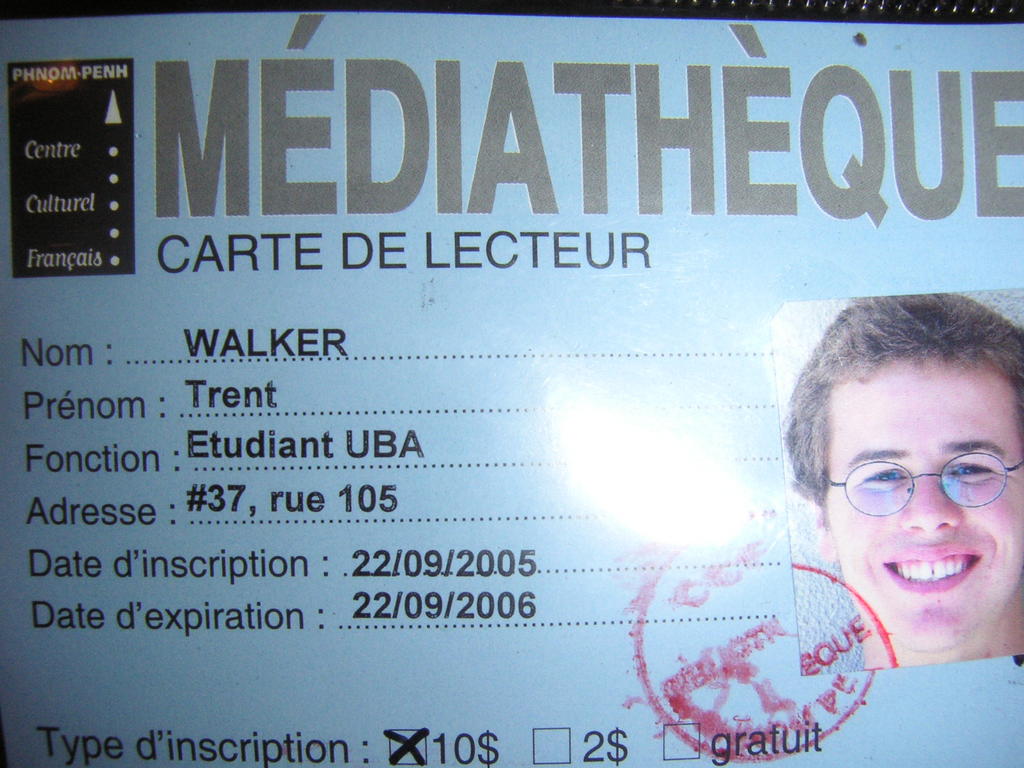
Aujourd'hui je suis allé au Centre Culturel Français à Phnom Penh. Au CCF je trouve une bibliothèque qui possède un grand nombre de livres sur le Cambodge, sur la langue khmère, et sur la religion cambodgienne. Pour faire des recherces au Cambodge, il faut lire en francais, car il n'existe tant de livres en anglais sur ce pays-là. Donc j'ai payé le tarif pour emprunter des livres--leur collection est tellement merveilleuse! De plus, le CCF est un endroit, très rare à Phnom Penh, ou on peut étudier et parler la langue française. Un petit erreur: ma carte de lecture dit que je suis un élève à l'Université Royale des Beaux Arts--ça ce n'est pas vrai, tant pis!

At the Desk


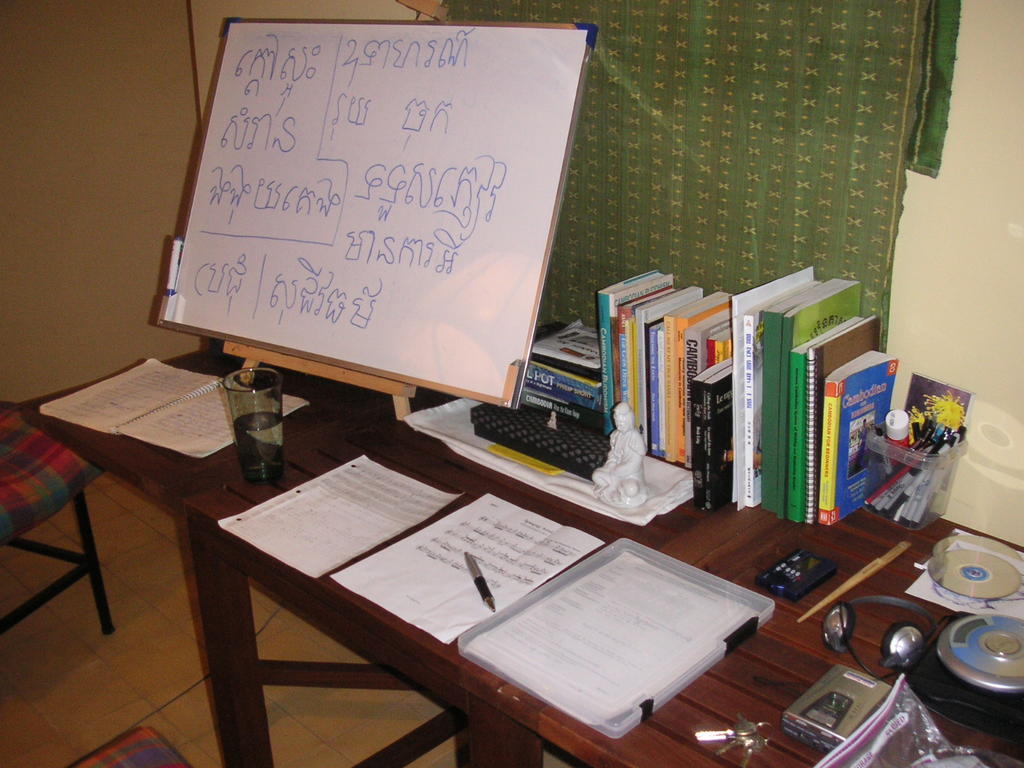
I've been spending a good deal of my time at my desk recently. I feel very fortunate to have the time to study this month. Studying Khmer is always fulfilling and the results are always quite tangible, but it is also just as compelling for me to read about new research in Cambodian Buddhism and then go out to local wat and observe what I have read about firsthand. I am very excited to be able to do some reseach of my own over the next couple of months.


I have also started working on transcribing some recorded smoat music and reading some translations of the chants. In order to really learn the music I will also need to know the meaning of the words, which are both in Khmer and Pali (an ancient Indian language). So while I have a good deal of work to look forward to, I am grateful that this kind of work is very fulfilling for me. And the music is all around me. When I walk through the streets and pass by a funeral, the smoat music, made even more eerie by the fact that is played on cassette tapes that have been copied way too many times, echoes between the building. And because I live across the street from a wat, if I rise at 4:30 AM (well worth it), I can hear both the chanting of the monks and live smoat chanting, because the Pchum Ben fesitival is currently taking place. Every hour of every day there is an opportunity to learn something new.


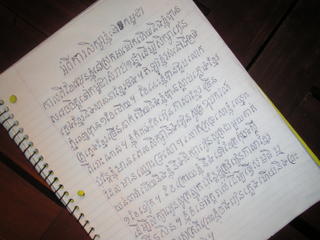
Silapak Khmer Amatak (SKA or Cambodian Living Arts) has asked me to write monthly updates of my progress. I wrote a first draft in Khmer (above), but when I finish a longer (and more gramatically correct) version in English, I'll post it here.

Sunday, September 18, 2005

Buddhism in Cambodia, part 2

The dominant religious tradition in Cambodia is not actually Buddhism; it is in fact a rich belnd of Buddhism, Brahmanism (usually placed under the larger category of Hinduism), animistic practices, and with the impact of the Chinese diaspora in the 19th and 20th centuries, Chinese folk beliefs. This syncretism has existed in Khmer society for many centuries dating back to the days of the Angkorian empire (c. 850-1450), the peak of Khmer civilization. Before the Angkorian period, Indian culture and Brahmanistic traditions gradually mixed with local folk beliefs over a period of about one thousand years. Angkor Wat and many of the other temples in the vicinity were built as Hindu monuments, although today they now house Buddha images. Angkor Wat, for instance, was built as a temple dedicated to the Hindu god Vishnu, and the bas-reliefs and iconography in the temple reflect Brahmanistic beliefs. In the 14th or 15th century, however, it was converted to a Theravada Buddhist wat to reflect the changing beliefs in the kingdom. Bayon, another famous Angkorian temple, was constructed under the orders of Jayavarman VII, a rather self-centered and megalomanical monarch who saw himself as an heir to the archetypal Buddhist kingship of Emperor Ashoka in India, and the temple displays tantric Mahayana Buddhist concepts popular with the Khmer elite at that time. But Jayavarman VII also built Brahmanistic monuments, so it is clear that kingdom maintained a tolerance for both Buddhist and Hindu beliefs. In short, syncretism is nothing new in Khmer society.

But what does Khmer religion look like today? My perspective, of course, is limited, because I tend to view Buddhism from a philosophical or practical point of view rather than one of faith or culture. Thus it is easier to consider most of the religious practices I see as having nothing to do with Buddhism, though many would say otherwise. For example, people often consult monks or achar (laypeople adept in rituals who often dress in white and spend most of their time in the wat) for astrological or other speculative purposes. Not only is fortune-telling specifically recommended against in the vinaya, it has very little to do with Buddhism.

When I was in Siem Reap, I visited a small wat in the forest near some the Angkorian temples. Near the vihear (main hall of the temple) a middle-aged monk was performing a ritual in which he splashes blessed water on a groups of praying recipients. I'm afraid that I don't know very much about the origins of this ritual, which is very common throughout Cambodia. Again, I don't mean to criticize in any way, but it points to a broad dichotomy in Cambodian Buddhism, between "traditionalists" who maintain that orthodoxy in Buddhism means these sort of "supernatural" rituals, practiced in Cambodia for centuries, and "modernists," who advocate a text-based study of Buddha's teaching and the elimination of "magical" elements. There is, of course, a great deal more subtlety to this dichotomy, and many shades of gray in between. But when I observe Buddhism in Cambodia, this is the dominant paradigm I see.

Now I have given a few examples of the traditionalist side of Buddhism in Cambodian, but I have also observed more modernist elements as well. I currently study vipassana meditation at Wat Langka three days a week. Vipassana, or insight meditation, was the practice heralded by Theravada Buddhist modernists in the early and mid-twentieth century and it continues to be taught and practiced by monastics and laypeople, both in Southeast Asia and the in the rest of the world. Even though other aspects of life at Wat Langka may be more traditionalist in character, there are still some monks who feel more connected to a more modernist approach.

When I was visiting Angkor Wat, Ratanak and I were looking closely at some Buddha images when we noticed that the pedestals that the sitting Buddhas were supported by were actually Brahmanistic yoni altars with the linga removed. Linga, phallic representations of the Hindu deity Shiva, are very common throughout Southeast Asia as a result of Brahmanistic religious influence. In many of the Angkorian temples near Siem Reap, there are many altars featuring linga and/or yoni, the female counterpart to the lingam. I suppose that as Angkor Wat was converted to a Theravada Buddhist temple hundreds of years ago, the people in charge simply plopped the Buddha images on top of the yoni, which made convient pedastals. I was slighlty bemused by this, but Ratanak seemed to think it was disrespectful to place a Buddha image on a non-Buddhist altar. To some extent it represents a misguided attempt at syncretism, but on the other it simply shows disrespect to both religious traditions. And for those that would like to see Buddhism "purifed" of Brahmanistic, superstituous, and animistic elements, it is just another symbolic representation of the dilution of Buddhist teaching.

As a closing example, when I had a chance to meet with Ven. Pin Sem at Wat Bo, he also mentioned some things that struck me as going against the grain of religion in Cambodia. Many people in all Buddhist countries and of all dispositions regularly offer incense and pray before a Buddha image. About this Ven. Pin Sem says (this a paraphrase of what I got through translation), "If you pray to Buddha, and make offerings to him, he won't help you. Indeed, Buddha won't help you at all. The key point is to rely on yourself. You are the only one who can help you. This is the difference between Buddhism and other religions. You can't go to God or to Buddha and ask him for help or ask for your sins to be forgiven. You have to work with the consequences of your own actions and work things out for yourself."

Saturday, September 17, 2005

Buddhism in Cambodia, part 1

When I realized that I was going to live in a Buddhist country for one year, I wasn't entirely sure what to expect. I knew the statistics, to some extent: 95% of the country's population is Theravada Buddhist, the rest mostly from historically Muslim ethnic groups or Khmers who have converted to Christianity. And I knew that a large percentage of Khmer men have been, are or will be monks for a period in their lives, although this percentage is much smaller than in pre-revolutionary times. Moreover, I knew I was going to encounter a large discontunity between the scriptural teachings of the Buddha--his message of rational inquiry, meditation, and liberation from suffering--and the actual practice of Buddhism in Cambodia. But on the whole I was unprepared for the forms of Buddhism and religious practice I have encounted so far.

In America I became closely acquainted with two Buddhist communities, both nominally from the Sino-Japanese tradition of Mahayana Zen Buddhism. While one stressed community life and rigorous meditation and the other put an emphasis on devotional chanting, they both essentially came from the same roots. Mahayana Buddhism, practiced in Vietnam, China, Korea, Japan, Mongolia, Tibet, and Bhutan, developed about 500 years after the death of the Buddha as a reaction to the tendency of Buddhist monastics to pay attention only to themselves and not to the wider community. Mahayana scriptures thus emphasize compassion and the ideal of dedicating one's life to the service of others. There are many more philosophical differences as well, but I think they are easy to stress too much. In truth, there is not that much difference between the two branches, especially at the level of everyday practice, and much progress has been made in the twentieth century to bring to the two schools back together.

Nevertheless, Theravada Buddhism emerged in a different cultural context than the Mahayana, so I am still a little lost when I walk into a Cambodian wat. The chanting, the bowing, the symbols, and the cultural traditionsare still mostly unknown to me. Whereas in Vietnam it was easy for me to feel comfortable and at ease in the temples, I am still a bit bewildered by the wats I have been to.

However, At the level of monastic discipline, there is very little significant difference between the two branches, and so I expected at least this to be similar in Cambodia to what I had seen in America. At one temple I became familiar with in San Francisco, the seven resident nuns maintained a strict observation of the Buddhist vinaya, the texts that detail the rules of monastic comportment. The nuns rise at 3:30 AM, meditate for several hours before beginning work around the temple after dawn, eat one meal a day before noon, and then work, study, and meditate until late in the evening, when they sleep sitting up in the lotus position until early the next day. The nuns always maintained a meditative atmosphere in temple, treated everyone with respect and quiet dignity. This kind of discipline is specifically outlined in Buddhist texts, and was advocated by the Buddha as providing a helpful structure to community life.

I do not generally making judgments about others whom I do not really know, but the discipline of the monks in Cambodia really suprises me. I am not used to seeing monks smoking, handling money, or chatting online. Of course, these are small things, but the discipline of the sangha as a whole does not seem to lend itself to the primary intention of Buddha's teaching, which is the release from attachment and suffering.

One possible reason for this is that most young men who enter the monkhood have no intention of studying and teaching dhamma for their whole lives. Some are monks for very brief periods as a way to honor their parents, some are seeking to escape from drug addiction or alcoholism, and still others are looking for a secular education to prepare them for a business career. There is nothing wrong with any of these reasons, and I don't want to criticize them, but they frankly have nothing to do with the Buddha's essential message of rational inquiry, meditation, and liberation.

The Cambodian sangha suffered a tremedous blow during the Khmer Rouge period, and over 80% of the monks living in Cambodia in 1975 died before 1980. So the sangha that did survive was one that was fractured and much smaller before, and without a doubt some of the continuity, traditions past down orally over 2,500 years, was lost. This again explains much of the state of the sangha today.

When Ratanak and I were visiting Angkor Wat, as a monk and another young man passed by us I heard a "rubber ducky" sound. I chuckled a little at hearing this quirky, quacky sound at a place as solemn as Angkor Wat, but Ratanak was clearly quite upset. She explained that monks are not supposed to behave like that (i.e. have a plastic squeaky toy under there robes as way to amuse themselves), and that she gets upset when she sees monks who aren't really interested in the monastic life (i.e. men who just want to say they are monks and get respected by others, but who still talk to their girlfriends on their cellphonesat night). For me, I was not really upset, because as a non-Khmer, I haven't grown up with the same feelings of reverence toward the sangha. But it did make me realize that many Cambodians are also not content about the discipline of the monks they support.

Of course, I do not mean to say that all the monks in Cambodia lack discipline; this is far from the truth. And they are all certainly more disciplined that I am as a layperson. I have met monks and visited wats where discipline is strong and alive and in whom I can sense the original teachings of the Buddha--to me this is very inspiring and moving to witness.

Friday, September 16, 2005

Tro sau jen, tro sau khmer

Last night I went to lohk gru (master-teacher) Yun Theara's house to study tro sau for the first time. As I didn't have a Khmer instrument of my own, I brought along my erhu (tro sau jen in Khmer) because the instruments are very similar. Yun Theara, a master of many Khmer instruments, especially those in the tro family, also has an erhu, so he was able to understand my instrument. Vice-Dean and Professor of Music at the Royal University of Fine Arts in Phnom Penh, Yun Theara is a well-respected Khmer musicologist who is also very knowledgable about Western musical theory and notation.

We started by discussing the various differences between the tro sau jen, tro sau thom (large tro sau), and tro sau dooj (small tro sau). I couldn't quite follow what he was saying, but I had a chance to watch him play the different instruments with great skill, rapidly transposing melodies for different instruments. I had heard him on recordings before and had even watched him play at a recording session, but I feel fortunate to now take lessons from him. Although I still don't understand Khmer music enough to appreciate his skill and aesthetic on the instrument, his musicianship and keen ear are very apparent, more so than in any other musician I have met in Cambodia.

The traditional way of teaching music in Cambodia is by rote memorization, and all of the classes I had seen so far used this method. Yun Theara, too, began to teach me a Khmer song, "Khmer Dom Benh," by playing it and having me repeat it back. This was pretty hard for me, as I have always learned music by reading notation, and I am not especially proficient on the erhu. But Yun Theara had also transcribed the song into Western notation, so I was able to read and remember it more easily. He is the only Khmer teacher I know who uses notation, in addition to rote memorization, to teach music.

Unlike most Chinese melodies, which are similar in phrasing and structure to many Western classical songs, Khmer melodies are very difficult for me to remember because the phrases seem so irregular and the meter of the tune is often obscured by rhythmically complex ornamentation. Again, while the Chinese pentatonic scale and system of temperment (tuning) is close to that used in the West, the Khmer scales use a different system of temperment. What this means is that when I hear I note in a Khmer song, it is sometimes between the notes of the Western scales I'm used to playing, so it sounds out of tune. Of course, it's not actually out of tune in terms of the Khmer scale, but my ear says it is. Khmer music even uses slightly different temperment when accompaning a male vocalist than when accompaning a female vocalist. I am excited to learn more about this music!

On a different note, my language teacher caught me off-guard by mentioning a music group called "The Monsters" or something like that. I was very confused, as I had never heard of any "Monsters" before, until he clarified himself and said "The Jazz Monsters." But I was still a little befuddled, because I had no idea how he had heard of my jazz combo before. And he mentioned it so casually that it sort of slipped below my radar. I suppose he followed some links from this blog, but in any event I am sure the other Jazz Monsters are happy to know that they are known even in Cambodia.