Reflections on Cambodia, Buddhism and Music

Thursday, December 29, 2005

Christmas in Cambodia


The language school in the village where I am living recently had a "Christmas" celebration. I say so because I don't really even recall the word "Christmas" being mentioned at all, or only in passing. The event was more of a singing and dancing contest for the students of the school. The older brother in family entered the duet competition with Srei Peu, the young woman I interviewed in a previous post. They won first place and a free year of study at the school.


I was asked to play the trumpet to accompany some students singing a traditional Khmer song. The song was about the process of harvesting rice in Cambodia, and many other students were involved in acting out the words of the song, especially the sifting of the rice. It was nice to finally have a chance to play the trumpet over here.


They asked me to give a speech, though I admit I was at a loss at what to say.

Saturday, December 17, 2005

Pictures from Ka Yeaw Village

Below are some more pictures that depict various aspects of life in the village.


Although I am focusing on studying smot, I have also been continuing my study on the tro sao, a Khmer stringed instrument.


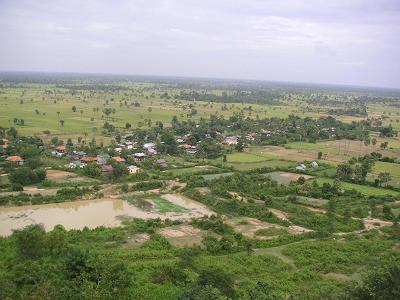
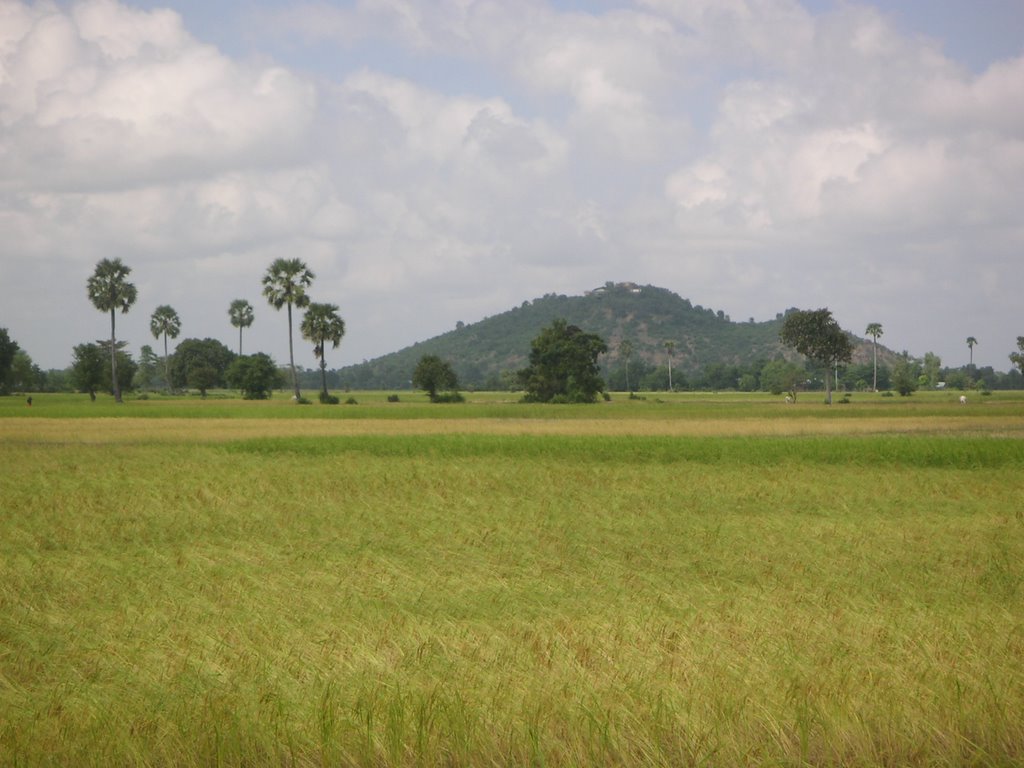
This is the stunning view, not really captured in the picture, from the top of the hill. The village in the picture is Tropeang Po village, where many of the smot students live.

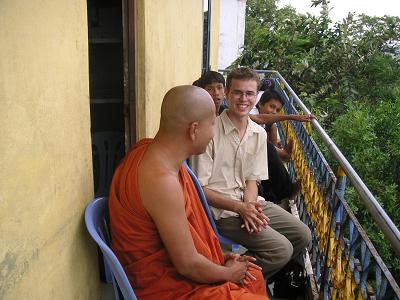
This young monk of 34 years is the abbot of the small monastery on top of the hill.

Neighbors frequently come to visit and chat. The jars behind store rainwater for domestic purposes.

This month is the time to harvest rice in Cambodia. Although my efforts did not help out very much, I did get a chance to learn to work different stages in the rice harvesting process (schything, threshing, etc.)

This is one of several "major" roads in the village, though its main traffic are carts pulled by cattle and people traveling by bicycle.

This is a rear view of the house where I am living. The large yard is mostly for cattle.

This small hall is main meeting center in the village and the site of most religious ceremonies. The well is used in the dry season when the rainwater has been used up. However, the well is currently in need of repair and most people use the pond instead.

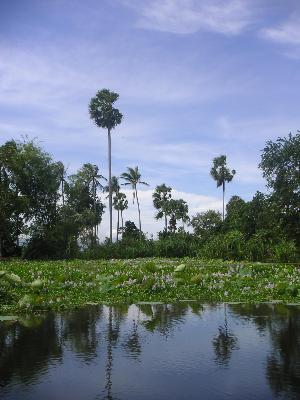
This is the main pond in the village, and where most people fetch water for household use. It is also a common place to bathe. To my knowledge, everyone boils their water before drinking it.

Wednesday, December 14, 2005

Scenes from the Speu


An aspring young trumpeter and his crafty assistants

Where I sleep and study

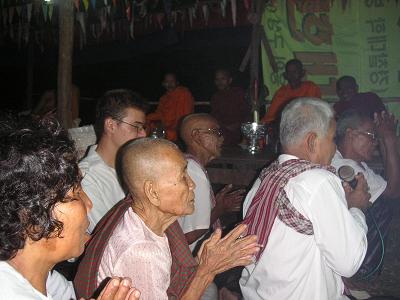
A memorial celebration in the village


Prum Uth (with the microphone) serving as MC (ta achary) at the memorial ceremony

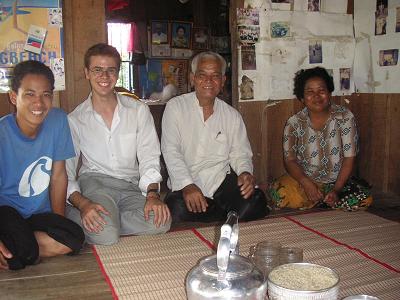
Left to right: Bunteang (son, 19), me, Prum Uth, and his wife.

"I Hope That We Will Have It Forever"

I recently conducted an interview for Cambodian Living Arts (CLA) in the village where I am studying smot in Kompong Speu. The aim of the interview was to get an idea of how the CLA class has changed the lives of the young smot students in the village.

Pheuan Srey Peu, 15, lives in Tropeang Po village in Kompong Speu Province, where she has been studying in CLA's smot (a form of vocal funeral music) class since January 2004. Currently a ninth-grade student at the local public school, Ms. Srey Peu had never had any musical training before the masters Prum Uth and Gaut Ran began to teach smot in a newly-founded CLA class almost two years ago.

Smot is a particulary difficult form of music for young Cambodians to learn because the melodies and vocal style are unlike any other form and the words of the songs use many Pali words and cryptic vocabulary that is often highly removed from everyday Khmer speech. Nevertheless, the form is deeply integral to Khmer culture, especially for Cambodian Buddhism, and when Srey Peu found out that the master musician Ieng Sithul would hold auditions for a smot class, she was immediately interested.

She had always loved traditional Khmer music, and was especially interested in singing. However, she had never had any opportunity to study these forms. In addition, she recalls that she liked going often to the local wat, offering food to monks, and listening to the elders of the village chant Buddhist scripture. Her only experience hearing smot, however, had been at the funerals she attended over the courser of her life, and before the smot class came to her village, she had not been interested in it.

Ms. Srey Peu has excelled in her studies of smot so far, and was quickly identified as one of the most promising students in the class, especially for her well-developed voice and amazing mental capacity to commit smot songs to memory. Even though she is still a student, she is frequently asks to perform smot songs at various functions at the local wats, much to the appreciation of the older members of the community.

In her words, "Before I began to study smot, I was interested in singing traditional Khmer songs, but I never I had the chance to study. So I only thought of myself as a normal, average person. After having studied smot, we have the feeling that we are special and extraordinary, because we are young and yet we know how to smot and we know about Buddhist chants." Srey Peu is known throughout the village and neighboring ones for her beautiful voice when she sings smot.

When she graduates from high school, Ms. Srey Peu says she is very interested in teaching smot to children, like the smot masters in the CLA class have done for her, because she wants the traditional smot songs of the Khmer people to not disappear and instead continue to be part of the rebirth of Khmer society.

Through CLA's smot class, Ms. Srey Peu has been able to discover and explore her talents a musician and smot singer, and thereby find direction to her life that she otherwise would not have had. She says that the class and her developing career in smot singing have given great joy and meaning in her life, and she now feels she has a chance to rise out of bleak future afforded by a life of farming in her village. Although she speaks truthfully that a good salary is probably the most important consideration for her future employment, she says that if a career solely based on teaching and performing smot would be a possibility for her, she would pursue this without hesitation.

Indeed, in the coming years such a career may be a possible one for her, but in truth, whatever career she ultimately pursues, smot singing and her passion for teaching it will be present, because in her own words, she says that "I don't want it to disappear, and hope that we will have it forever."

Saturday, December 03, 2005

Up on the heights

Some of the students in the smote class and I recently had a chance to hike up the mountain pictured below. The view from the top is incredible, and I'm afraid that the photos below don't really capture that. I will write more about my experiences here soon, but in short, living in this village has been one of the happiest times of my life. The friends I've made, the kindness of the neighbors, the beauty of the landscape, the talent of my fellow students of smote, the wisdom of my teachers--all are indescribable and I feel very grateful to be here.


Saturday, November 26, 2005

Queen Maya's Lamentation

I've currently been helping out with one of Cambodian Living Arts' CD projects. The song translated below has been proposed to appear on a CD feauturing various kinds of tradtional Khmer music, including smote. For the liner notes, I have worked on researching background info on this particular song and writing an English translation for it.

The name of the song is, in an English transciption of the Khmer, "Tumnuonh Neang Sere Moha Maya." An appropriate English translation would be "Lamentation of Queen Maya."

The context of this song is similar to other smote pieces, in that it used primarily in funeral ceremonies, particularly when a sick person is on verge of death. Smote songs, which recount Buddhist teachings or stories in poetic form, are used to direct the mind of the dying person towards the Buddhist trinity, or Three Jewels: the Buddha, his teaching, and his disciples, so that they will be reborn in a favorable realm. This particular ceremony is called samwek, and this particular song is one of many that can be used for that occasion, to be sung by either monks or laypeople.

The content of the song is centered around the Buddha's mother, Queen Maya, lamentation for her son, who has left the palace where he was a prince and heir to the throne, gone deep into forest, and taken up extreme austerities, including eating very little food, in order to reach enlightenment. The Buddha later realized the futility of his efforts and accepted food in order to nourish his body and mind, after which he finally attained enlightenment. Before this, however, he became extremely thin and weak, to the point that he was practically only skin and bones, and the shape his backbone became visible from the front. Queen Maya, having died only seven days after his birth, is told by her fellow gods in the realms of heaven that her son, now in his thirties, has become very weak and emaciated. It is at this point that she begins her lament.

This particular song is closely related to another that I have been studying, called "Bandam Neang Moha Maya Devi Jampuah Neang Goutamei," or "The Admontions of the Buddha's Mother Maya for Lady Gotami." A translation of this song follows below the translation of "Lamentation of Queen Maya."

Lamentation of Queen Maya (Tumnuonh Neang Sere Moha Maya)

O my son, my dear son!
You have become so thin and weak.
And your mother feels great sorrow for you,
Sorrow that exceeds all comparison.

O my child, seven days after your birth,
Your mother suddenly passed from this world,
And ascended to the highest realms of heaven,
Where she now resides with the gods.

I, your mother have heard from the gods
That you, my child, were born into a beautiful body,
Magnificent in form and free from disgrace.
So now why have you become so emaciated?

Your mother has come to see your body, O child!
She feels great sorrow, and her heart
Grows soft with pity to see you like this.
For what reason do you do this, my son?


The Admontions of the Buddha's Mother Maya for Lady Gotami (Bandam Neang Moha Maya Devi Jampuah Neang Goutamei)

"Dear Lady Gotami, o younger sister!
Please remember this advice
That I admonish so strongly on to you.
Please, younger sister, be kind and forgiving to me.

"Elder sister gave birth to a beloved son,
Only to live as a his mother for seven days.
Seven days, younger sister!
Death came and blocked my path.

"Sister, this child is remarkable indeed.
Wise sages came to pay respect to him.
His is called Siddartha according to the law.
For the benefit of all living beings,

"Our beloved son will attain enlightenment,
Knowing all paths to salvation by his own effort.
Many will come to ask for his help,
Granting abundant happiness to humans and gods alike.

"Younger sister! Please be determined
And have compassion for this child.
Let him suckle at your breast
And care for him with your own hands.

"Sister, don’t lost your fortitude
And call on servants to care for him.
Raise him with your own strong arms
And know that this is true love."


Having finished giving her admonitions,
She passed away and her life was finished,
To be reborn in the Tusita heaven,
Resplendent in numberless colors and powers.

The reason that Queen Maya was born
In the blissful Heaven of the Thirty-three,
Is that many gods there could inform her
About the exceeding virtue of her beloved son.

There came a time when the Buddha
Wandered back and forth across a stretch of forest
Staying for four reasons
In the Uruvela forest in the city of Gaya.

His body grew emaciated till his bones poked through,
His eyes grew bleary, wide-open beyond description,
As he collapsed down to the earth,
Enduring terrible suffering but still alive.

At that time the beautiful Queen Maya
Descended from paradise to come take a look
At the body of the Blessed One.
I humbly now finish this poem.


Friday, November 25, 2005

Written Culture

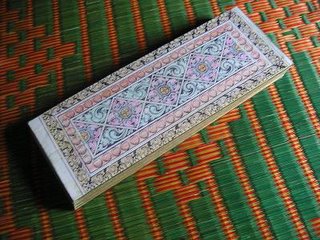
My smote teacher, Proum Uth, is also the head layperson (ta achar) at a temple on the outskirts of Phnom Penh, and one day, when he returned his wat back to Kompong Speu, he came with a most unusual book, unlike any I had ever seen in Cambodia. The book brick-shaped, narrow but long and thick,


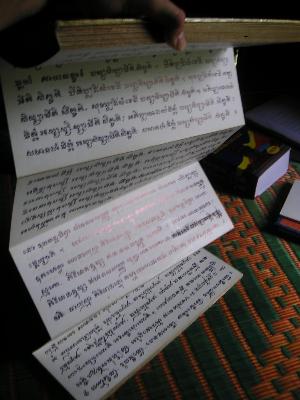
and opened in a concertina arrangement, rather like an accordion.

Inside the book were hand-written texts for the smote songs most often used at funeral ceremonies,

written in unfailingly beautiful Khmer script.

He later explained that this sort of manuscript was called a krang. We then began to study some the smote songs contained within. After doing some more research on the subject, I found out some more information on the history of this kind and other kinds manuscripts in Cambodia.

The history of written culture in Cambodia begins with the history of Buddhist scriptures. The teachings of the Buddha were passed down orally for about five hundred years before monks began to start writing them down on palm leaves. This tradition of palm-leaf manuscripts came to Cambodia with the spread of Buddhism, especially with the conversion of the kingdom to the Theravada branch of the religion in the 13th century. Khmer palm-leaf manuscripts were mainly used in wats to be studied and recited by the monks. Mostly written in Khmer script representing the sounds of the Pali language, palm-leaf manuscripts are difficult to handle and to study, and reading them is an art in itself. Thus the Khmer script used in the manuscripts came to be associated with mystical powers, and many rituals developed around the their use. Palm-leaf manuscripts do not last very long, and today very few Cambodian manuscripts remain from before the 19th century. They were regularly burned as a way of making merit and then recopied onto new leaves. This tradition survived as the main method of recording Buddhist scriptures and literature well in the 19th century.

The krang developed later than the palm-leaf manuscripts, but has also been a traditional method of storing Buddhist scriptures throughout Asia. Most temples in China and Japan have collections of this kind of manuscript, both for ritual use and for study. In Cambodia, krang are produced on paper made from mulberry leaves, hand-written in ink, and then bound in a folding arrangement. They generally last longer than palm-leaf manuscripts but are nearly as difficult to produce, as no printing technology is used.

With the onset of the French protectorate in Cambodian in the late 19th century, as well as the influence of reformed Siamese Buddhism from Thailand, the culture of palm-leaf and other manuscripts in Cambodia began to change. In order to increase their control over the Buddhist clergy, the French colonial government establised the Buddhist Institute in the early part of the 20th century. The Buddhist Institute set about to produce a complete translation of the Tripitaka (the corpus of Buddhist scriptures) in Khmer, at a time when most temples in Cambodia lacked even a complete Pali version of the scriptures. The was initially much resistance to the move away from hand-written manuscripts among traditionalist monks, who sensed a magic power in the ancient Khmer letters and the rituals associated with them and therefore feared a change in how the teachings of the Buddha were respected. However, although there are monks who still use the palm-leaf manuscripts, serious monastic students more often used printed literature to understand the words of the Buddha. The Buddhist Institute also printed the first Cambodian dictionary, under the leadership of Buddhist patriarch Chuon Nath, which is still the only Cambodian dictionary in use today, to my knowledge. Most importantly, the Buddhist Institure made possible the advent of print culture in Cambodia, and they have printed many hundreds of small and large volumes alike on Buddhism and traditional literature over the past seventy years. Thus most Buddhist education has changed from being focused on palm-leaf or krang manuscripts to printed books.

Today, printed books are available very cheaply in Cambodia, usually starting from around 25 cents. This is because most of the titles, both foreign and domestic, are photocopied from the original publications. Some would caracterize Cambodia as not being a very literary culture, although I would argue that this is not the case. Traditional literature is, however, to some extent endangered in Cambodia, like some many other traditional arts forms. Furthermore, the traditional manuscripts may be lost if efforts are undertaken to preserve them.

For me, it's really an honor and a wonderful opportunity to be able to study smote from the krang manuscripts and learn about the care and effort that had to go into each word before the advent of printing in Cambodia. As of late, I have been learning to type in Khmer, which is a rather slow and cumbersome process, in order to record some of the smote texts found in the manuscripts and in other sources. Even if typing now seems slow, it is fascinating to think about how much the culture around written texts in Cambodia has changed over the past one hundred years.

Thursday, November 24, 2005

Three-Month Report

I suppose at this point, three months into my time in Cambodia, that I should be used to the fact that one year is indeed not very long at all. While a day in the countryside seems long and certainly tends to unfold in a more natural way than in the city, I am continually faced with the realization that in the blink of an eye my time in Kompong Speu will be over and I will be off to Siem Reap to pursue monastic ordination. Although it seems crude to do so, I will try to sum up what I have accomplished since mid-August as a way for me to make a more informed assessment of what goals I would like to pursue over the next few months.

From one perspective, I really have no idea how much my Khmer has progressed, as not being a native speaker, I have no ear for whether my accent is reasonably acceptable or if my grammar accords with modern conventions or not. However, I do know that my language skills have improved somewhat since last month, particularly in the areas of reading and listening. As I have been focusing most of my attention on the literary, Pali-laden Khmer that smote songs employ, most of my progress has been in understanding this particular style. For the most part, I am able to read texts of smote songs and understand what they are about, and with the aid of a dictionary, I can produce a reasonably coherent translation. At this point, I have stopped taking language lessons, and I notice that my speaking and writing skills, in particular, are falling behind. The smote masters obviously simplify their language when they speak with me, so I can usually understand what they are saying without difficult. Nevertheless, when it comes time to respond to them, I am often lost for words. I hope that I will have more chances to work on this.

I have been continuing my study of the tro sao, and I generally find time to practice the eight songs I have learned so far. However, my teacher Yun Theara has been, understandably so, very busy, and I have only been able to study with him on an occasional basis, about every two weeks. I have really enjoyed my studies so far, and have had some chances to share some Mahaori songs with the people in Ka Yeaw village, where I am staying in Kompong Speu.

Additionally, I have also had the opportunity to spend a good deal of time researching Khmer Buddhism, and more specifically the literature associated with Theravada Buddhist funeral rites. I have had a few chances to do relatively independent research in the past, but this is the first time that I really had no idea what I would find over the course of my research. At this point, I have identified most of the relevant English and French language material on Khmer Buddhist rituals and literature and am presently in the process of reading, rereading and taking notes on these sources. I also searching for Khmer-language sources, which has been very rewarding, and I look forward to discovering more useful texts through this process.

Now on my third week in the countryside, I am realizing the challenges of studying smote. Once I translate a particular text into English and have a clear idea of its content, I find that it is not too difficult to memorize the Khmer words, although the length of the songs certainly requires that memorization takes a significant time commitment on my part. The melodies also stretch my musical capabilities as their freedom from Western standards of rhythm and meter makes them very difficult to transcribe accurately. However, the hardest part about learning smote songs for me is pronouncing Khmer words correctly. Certain sounds in the Khmer language are very difficult for me to pronounce clearly, and I know that I will continue to struggle with these sounds as I continue my study. I am very grateful that the masters are patient enough to accommodate for my deficiencies.

As for the coming months, I have a clear idea of what path my research and writing will take. I hope that I will soon be able to find a mentor for this project, a process that should give me more direction and point out some of the many gaps and oversights in my research. I am less sure, however, about the actual study of smote. Some of the more difficult songs reportedly take months to learn, and while my pace of learning may be different, I do not have high expectations for learning more than a handful of smote songs. In my view, learning just a few songs well will be ultimately more important, to both my research and my understanding of the art more.

At the urging of my teacher Proum Uth, I have begun to study the Pali and Khmer chants used in the novice ordination ceremony. Although he recommended this course of study in order to prepare me for the monkhood, the study of Pali chants, in particular, is helping me with the pronunciation of the regular Khmer smote songs, as well as teaching me about the Pali chants used in the funeral ceremonies of which smote is a part.

Overall, I am very happy to have come to this point after three months here and I am especially grateful to have met so many people who were so willing to help me in surprising and wonderful ways. I am cautious in terms of my expectations for myself, and I hope that in the coming weeks I am able to find more direction and sense of purpose for my studies here.