Although I cannot say that I have been regularly updating this blog, this post indeed will be the last one for a while. On Monday, I am ordaining as a novice monk at Wat Rajabo, Siem Reap Province, and will most likely disrobe in late June. I do not plan on using a computer regularly during this time, though the occasion may present itself. I will also check my email tomorrow. I feel very fortunate that I have this time to concentrate on looking inside.
May you and all beings be filled with loving-kindness, peace, well-being and happiness.
Friday, February 10, 2006

Monday, January 23, 2006
Thoughts and Goals
I have now been in Cambodia for almost five months, and I am beginning to see that I may be very pressed for time from June to September in order to accomplish my goals here. Therefore, I am trying to take what time I have now to reflect on what I have so far accomplished and what goals I would like to achieve before heading back home.
Although this was largely unavoidable and yet rather unanticipated by me, my five months here have rapidly clarified what I want to pursue in college. Thus I am trying to keep in mind that I do not have to study everything about Cambodian Buddhism in the next eight months, and that I hopefully have many more years to learn. That said, I am trying to focus on studying what I only could study in Cambodia, and especially knowing that I have the opportunity to live in the countryside and relative freedom to meet with people in various temples. My goals for the rest of my time here thus reflect these considerations.
The goal that comes to mind first is to develop a catalogue of as many smot pieces as possible. The principle of this is simple: in order to make sure that rarer pieces are not lost, it is necessary to keep track of the songs that are currently in the canon of smot pieces. In a short amount of time, I do not expect to become familiar with the entire extant repetoire of smot pieces. However, I do see it to be very possible to come up with a somewhat complete catalogue and determine from what patterns are revealed how many other songs may exist. For the catalogue, I am trying to record as much as possible of the following information:
Title
Alternative titles
Possible Author/editor
Published texts sources
Palm-leaf and other manuscript sources
Variations between various text sources
Melody used for this piece
Poetic meter
Recordings of this piece
Source in Pali Tipitaka
Teachers who know this piece
Thus far, I have partial information for about 60 songs. At this point, it is hard to determine how many other smot songs exist, although I would currently estimate that it would probably exceed 100 hundred. Part of the dilemma is deciding which texts count as “smot” as which do not.
As I will soon be entering a monastery in Siem Reap to ordain as a monk for about four months, most of my research will have to wait until June, when I disrobe and return to Phnom Penh. During my stay in the monastery, I do not plan to continue research of any kind, but rather will try to experience Cambodian Buddhism from the inside out. When I get back, one of my goals will be to learn as much as I can from my teacher, Master Prum Ut, in Kompong Speu, especially in terms of his vocal technique. Additionally, I plan to organize a studio recording session of Prum Ut and possibly other smot masters in order to ensure that their knowledge is not lost.
At this point, I have developed a fairly extensive bibliography, but I have not had a chance to follow up on the palm-leaf sources for many of the texts I am looking at. This is one of the most tedious aspects of my research, though for the most part I would consider it to be exciting rather than tedious. Moreover, I am unsure of my ability to read “middle-period” Khmer, which at times differs substantially, especially in spelling, from its modern counterpart. My main purpose then will be to identify and gather copies of relevant texts for future study.
Over the last five months, I have met with various professors, achars, monks, and students and asked them about smot. By sifting through and analyzing their various perspectives, I am getting closer to full picture of smot in Cambodian society. However, I intend to continue to search out knowledgeable people on the subject in order to hear from as many perspectives as I can.
One final project I would like to complete while I am here is to do some preliminary research on trai leak funeral music in Siem Reap. Besides from being, in my opinion, some of the most beautiful Khmer music, trai leak is very close to extinction, with only a few living masters, all of whom who are quite elderly. This form of music, in many ways closely related to smot, is covered only briefly in writings about Cambodian music, and early questioning has revealed that possibly only 20 or less songs are currently known. I am planning to spend a couple of weeks in Siem Reap this summer in order to gather what information I can about this art.
On a whole, I feel like I have been on the right track so far in my research, and I am prepared for many more surprises along the way. When I came to Cambodia, I really had know I idea what I was getting into. From this point on, what I hope most is that I can keep an open mind about what I have learned so far, so that what new information and perspectives present themselves to me, I can see them in a fresh way and not be hampered by my own limited perspective.
Although this was largely unavoidable and yet rather unanticipated by me, my five months here have rapidly clarified what I want to pursue in college. Thus I am trying to keep in mind that I do not have to study everything about Cambodian Buddhism in the next eight months, and that I hopefully have many more years to learn. That said, I am trying to focus on studying what I only could study in Cambodia, and especially knowing that I have the opportunity to live in the countryside and relative freedom to meet with people in various temples. My goals for the rest of my time here thus reflect these considerations.
The goal that comes to mind first is to develop a catalogue of as many smot pieces as possible. The principle of this is simple: in order to make sure that rarer pieces are not lost, it is necessary to keep track of the songs that are currently in the canon of smot pieces. In a short amount of time, I do not expect to become familiar with the entire extant repetoire of smot pieces. However, I do see it to be very possible to come up with a somewhat complete catalogue and determine from what patterns are revealed how many other songs may exist. For the catalogue, I am trying to record as much as possible of the following information:
Title
Alternative titles
Possible Author/editor
Published texts sources
Palm-leaf and other manuscript sources
Variations between various text sources
Melody used for this piece
Poetic meter
Recordings of this piece
Source in Pali Tipitaka
Teachers who know this piece
Thus far, I have partial information for about 60 songs. At this point, it is hard to determine how many other smot songs exist, although I would currently estimate that it would probably exceed 100 hundred. Part of the dilemma is deciding which texts count as “smot” as which do not.
As I will soon be entering a monastery in Siem Reap to ordain as a monk for about four months, most of my research will have to wait until June, when I disrobe and return to Phnom Penh. During my stay in the monastery, I do not plan to continue research of any kind, but rather will try to experience Cambodian Buddhism from the inside out. When I get back, one of my goals will be to learn as much as I can from my teacher, Master Prum Ut, in Kompong Speu, especially in terms of his vocal technique. Additionally, I plan to organize a studio recording session of Prum Ut and possibly other smot masters in order to ensure that their knowledge is not lost.
At this point, I have developed a fairly extensive bibliography, but I have not had a chance to follow up on the palm-leaf sources for many of the texts I am looking at. This is one of the most tedious aspects of my research, though for the most part I would consider it to be exciting rather than tedious. Moreover, I am unsure of my ability to read “middle-period” Khmer, which at times differs substantially, especially in spelling, from its modern counterpart. My main purpose then will be to identify and gather copies of relevant texts for future study.
Over the last five months, I have met with various professors, achars, monks, and students and asked them about smot. By sifting through and analyzing their various perspectives, I am getting closer to full picture of smot in Cambodian society. However, I intend to continue to search out knowledgeable people on the subject in order to hear from as many perspectives as I can.
One final project I would like to complete while I am here is to do some preliminary research on trai leak funeral music in Siem Reap. Besides from being, in my opinion, some of the most beautiful Khmer music, trai leak is very close to extinction, with only a few living masters, all of whom who are quite elderly. This form of music, in many ways closely related to smot, is covered only briefly in writings about Cambodian music, and early questioning has revealed that possibly only 20 or less songs are currently known. I am planning to spend a couple of weeks in Siem Reap this summer in order to gather what information I can about this art.
On a whole, I feel like I have been on the right track so far in my research, and I am prepared for many more surprises along the way. When I came to Cambodia, I really had know I idea what I was getting into. From this point on, what I hope most is that I can keep an open mind about what I have learned so far, so that what new information and perspectives present themselves to me, I can see them in a fresh way and not be hampered by my own limited perspective.
Tuesday, January 10, 2006
Four Month Report
The past month has brought many new developments to my project. I do not hesitate to say that each succeeding month seems to go by faster than the one before, but I am also aware that each month I can see more and more clearly what I am doing here. I have about one more month here in Kompong Speu before I head off to pursue novice ordination in Siem Reap. After four months in robes, I plan to return to Kompong Speu at the end of June for another couple of months of smot study.
As of now , my listening and reading skills have improved from before, and generally I do not have much trouble understanding what people are saying to me or around me. For the most part, books written in Khmer are accessible to me, although I read rather slowly. I have not devoted much time to my speaking and writing skills, however, and subsequently, these areas have not seen much improvement. I have no trouble communicating, but at this point my grasp of Khmer grammar in not sufficient to confidently express complex ideas.
I am learning a lot, however, about the contextual nature of the Cambodian language and I now find myself speaking very differently in varying situations. This is especially true when I make the transition between the city and the countryside. In both Phnom Penh and Kompong Speu, dialects of Khmer are spoken that do not correspond to the standard language taught in schools and heard on television or radio. For example, when taking to a university professor in the capital I tend to use more standard Khmer and more grammatically correct expressions. If I am in a crowded market in Phnom Penh, trying to catch a bus to the countryside, I tend to speak more abruptly and in line with the urban dialect. I n the countryside, I usually need to speak differently to in order to be understood and match the pronunciation of those around me.
In continue to be very excited about my research. My understanding of smot, while still shallow, continues to develop as I investigate more primary and peripheral sources on the topic. Through the libraries in Phnom Penh, I continue to find small insights into smot from a wide variety of source materials. I have also begun to search for more primary literature on smot, especially folding-paper manuscripts (krang) and palm-leaf manuscripts (sastra sloek rit). A trip to a significant wat in Kandal Province where my smot teacher is an achar proved fruitful in many respects, but no ancient or modern manuscripts turned up. I have made contacts with researchers in at the National Library in Phnom Penh as well as at the École française d’extrême-orient and some manuscripts seem to be available. I am waiting for further results in this area.
However important literary sources may be, I know that my most important sources are real people. In addition to my teachers in Kompong Speu, I have begun to study Khmer poetry with a teacher in Phnom Penh and have also begun to study smot chanting of secular poetry from Yang Borin, who teaches smot and poetry at the Royal University of Fine Arts. Both of these teachers have significantly advanced my understanding of the subject.
Back in Kompong Speu, I have been studying intensively with Prum Ut, who graciously gives five hours of his time each day to teach me. At this point, I have studied seven songs from him, although on some of the longer songs (15 minutes or more), I am choosing to not memorize the entire texts, as this would take more time that I have. I am trying to focus on studying the smot songs that Prum Ut considers to be the oldest and least heard today, some of which are apparently only known by him. In addition, I have also been studying the most important Pali chants used in Cambodia as well as the chants needed for the novice ordination ceremony and the daily life of the monks. The study of these chants has been especially helpful for me, as it has given me the skills to pronounce and chant Pali on my own, although I do not understand the meaning of most of the words. Additionally, Prum Ut has taught me a lot about the uses of these Pali chants as well as the smot songs. I have been able to see him “on the job” at many ceremonies, but in the village and at his wat, and these experiences have given me a much better understanding of smot and it place within Cambodian Buddhism.
Life is the village in Kompong Speu is equally rewarding in itself. In general, I end up teaching English a couple of hours a day, at several different local schools as well as for the CLA smot students on the weekends. Prum Ut’s family has become like another family to me, and I have grown close to his sons and I am pleased to see their English skills continue to improve as I practice with them. Furthermore, traditional life in the village shines light on everything in Cambodian culture, from the language to the religion, from its history to its music. I wake up to the sound of threshing rice, eat breakfast as the pin peat music of a ceremony drifts across the fields, study to the voices of monks chanting in a local temple, and fall asleep to the wedding music piped through speakers in a neighboring village. In short, so much of what I learning come from my environment and not from books or even from teachers. I have learned that the most important thing is to simply open my ears and my eyes.
As of now , my listening and reading skills have improved from before, and generally I do not have much trouble understanding what people are saying to me or around me. For the most part, books written in Khmer are accessible to me, although I read rather slowly. I have not devoted much time to my speaking and writing skills, however, and subsequently, these areas have not seen much improvement. I have no trouble communicating, but at this point my grasp of Khmer grammar in not sufficient to confidently express complex ideas.
I am learning a lot, however, about the contextual nature of the Cambodian language and I now find myself speaking very differently in varying situations. This is especially true when I make the transition between the city and the countryside. In both Phnom Penh and Kompong Speu, dialects of Khmer are spoken that do not correspond to the standard language taught in schools and heard on television or radio. For example, when taking to a university professor in the capital I tend to use more standard Khmer and more grammatically correct expressions. If I am in a crowded market in Phnom Penh, trying to catch a bus to the countryside, I tend to speak more abruptly and in line with the urban dialect. I n the countryside, I usually need to speak differently to in order to be understood and match the pronunciation of those around me.
In continue to be very excited about my research. My understanding of smot, while still shallow, continues to develop as I investigate more primary and peripheral sources on the topic. Through the libraries in Phnom Penh, I continue to find small insights into smot from a wide variety of source materials. I have also begun to search for more primary literature on smot, especially folding-paper manuscripts (krang) and palm-leaf manuscripts (sastra sloek rit). A trip to a significant wat in Kandal Province where my smot teacher is an achar proved fruitful in many respects, but no ancient or modern manuscripts turned up. I have made contacts with researchers in at the National Library in Phnom Penh as well as at the École française d’extrême-orient and some manuscripts seem to be available. I am waiting for further results in this area.
However important literary sources may be, I know that my most important sources are real people. In addition to my teachers in Kompong Speu, I have begun to study Khmer poetry with a teacher in Phnom Penh and have also begun to study smot chanting of secular poetry from Yang Borin, who teaches smot and poetry at the Royal University of Fine Arts. Both of these teachers have significantly advanced my understanding of the subject.
Back in Kompong Speu, I have been studying intensively with Prum Ut, who graciously gives five hours of his time each day to teach me. At this point, I have studied seven songs from him, although on some of the longer songs (15 minutes or more), I am choosing to not memorize the entire texts, as this would take more time that I have. I am trying to focus on studying the smot songs that Prum Ut considers to be the oldest and least heard today, some of which are apparently only known by him. In addition, I have also been studying the most important Pali chants used in Cambodia as well as the chants needed for the novice ordination ceremony and the daily life of the monks. The study of these chants has been especially helpful for me, as it has given me the skills to pronounce and chant Pali on my own, although I do not understand the meaning of most of the words. Additionally, Prum Ut has taught me a lot about the uses of these Pali chants as well as the smot songs. I have been able to see him “on the job” at many ceremonies, but in the village and at his wat, and these experiences have given me a much better understanding of smot and it place within Cambodian Buddhism.
Life is the village in Kompong Speu is equally rewarding in itself. In general, I end up teaching English a couple of hours a day, at several different local schools as well as for the CLA smot students on the weekends. Prum Ut’s family has become like another family to me, and I have grown close to his sons and I am pleased to see their English skills continue to improve as I practice with them. Furthermore, traditional life in the village shines light on everything in Cambodian culture, from the language to the religion, from its history to its music. I wake up to the sound of threshing rice, eat breakfast as the pin peat music of a ceremony drifts across the fields, study to the voices of monks chanting in a local temple, and fall asleep to the wedding music piped through speakers in a neighboring village. In short, so much of what I learning come from my environment and not from books or even from teachers. I have learned that the most important thing is to simply open my ears and my eyes.
Thursday, December 29, 2005
Christmas in Cambodia

The language school in the village where I am living recently had a "Christmas" celebration. I say so because I don't really even recall the word "Christmas" being mentioned at all, or only in passing. The event was more of a singing and dancing contest for the students of the school. The older brother in family entered the duet competition with Srei Peu, the young woman I interviewed in a previous post. They won first place and a free year of study at the school.

I was asked to play the trumpet to accompany some students singing a traditional Khmer song. The song was about the process of harvesting rice in Cambodia, and many other students were involved in acting out the words of the song, especially the sifting of the rice. It was nice to finally have a chance to play the trumpet over here.
 They asked me to give a speech, though I admit I was at a loss at what to say.
Saturday, December 17, 2005
Pictures from Ka Yeaw Village
Below are some more pictures that depict various aspects of life in the village.
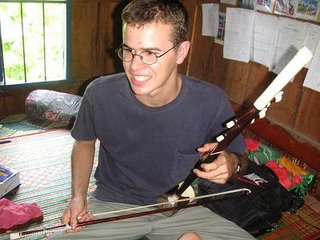
Although I am focusing on studying smot, I have also been continuing my study on the tro sao, a Khmer stringed instrument.

Although I am focusing on studying smot, I have also been continuing my study on the tro sao, a Khmer stringed instrument.
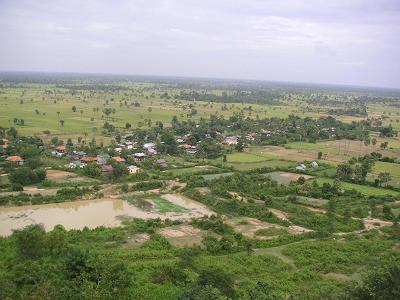
This is the stunning view, not really captured in the picture, from the top of the hill. The village in the picture is Tropeang Po village, where many of the smot students live.
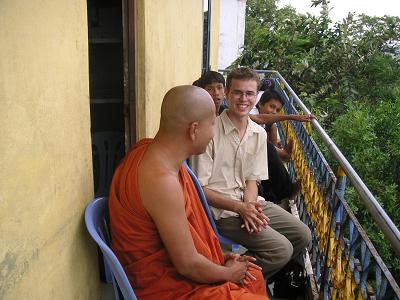 This young monk of 34 years is the abbot of the small monastery on top of the hill.
 Neighbors frequently come to visit and chat. The jars behind store rainwater for domestic purposes.
 This month is the time to harvest rice in Cambodia. Although my efforts did not help out very much, I did get a chance to learn to work different stages in the rice harvesting process (schything, threshing, etc.)
 This is one of several "major" roads in the village, though its main traffic are carts pulled by cattle and people traveling by bicycle.
 This is a rear view of the house where I am living. The large yard is mostly for cattle.
 This small hall is main meeting center in the village and the site of most religious ceremonies. The well is used in the dry season when the rainwater has been used up. However, the well is currently in need of repair and most people use the pond instead.
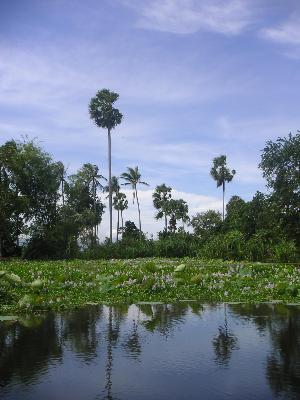 This is the main pond in the village, and where most people fetch water for household use. It is also a common place to bathe. To my knowledge, everyone boils their water before drinking it.
Wednesday, December 14, 2005
Scenes from the Speu

An aspring young trumpeter and his crafty assistants
 Where I sleep and study
 A memorial celebration in the village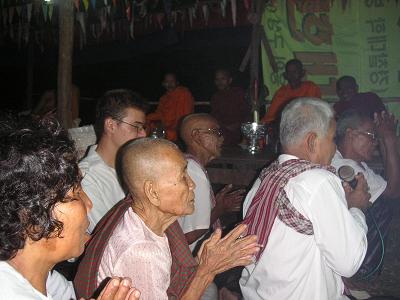
Prum Uth (with the microphone) serving as MC (ta achary) at the memorial ceremony
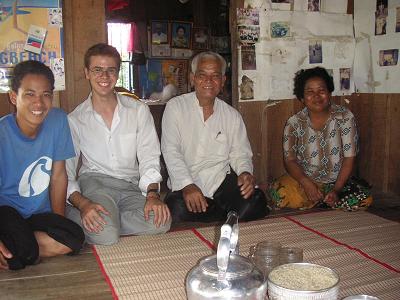
Left to right: Bunteang (son, 19), me, Prum Uth, and his wife.
"I Hope That We Will Have It Forever"
I recently conducted an interview for Cambodian Living Arts (CLA) in the village where I am studying smot in Kompong Speu. The aim of the interview was to get an idea of how the CLA class has changed the lives of the young smot students in the village.
Pheuan Srey Peu, 15, lives in Tropeang Po village in Kompong Speu Province, where she has been studying in CLA's smot (a form of vocal funeral music) class since January 2004. Currently a ninth-grade student at the local public school, Ms. Srey Peu had never had any musical training before the masters Prum Uth and Gaut Ran began to teach smot in a newly-founded CLA class almost two years ago.
Smot is a particulary difficult form of music for young Cambodians to learn because the melodies and vocal style are unlike any other form and the words of the songs use many Pali words and cryptic vocabulary that is often highly removed from everyday Khmer speech. Nevertheless, the form is deeply integral to Khmer culture, especially for Cambodian Buddhism, and when Srey Peu found out that the master musician Ieng Sithul would hold auditions for a smot class, she was immediately interested.
She had always loved traditional Khmer music, and was especially interested in singing. However, she had never had any opportunity to study these forms. In addition, she recalls that she liked going often to the local wat, offering food to monks, and listening to the elders of the village chant Buddhist scripture. Her only experience hearing smot, however, had been at the funerals she attended over the courser of her life, and before the smot class came to her village, she had not been interested in it.
Ms. Srey Peu has excelled in her studies of smot so far, and was quickly identified as one of the most promising students in the class, especially for her well-developed voice and amazing mental capacity to commit smot songs to memory. Even though she is still a student, she is frequently asks to perform smot songs at various functions at the local wats, much to the appreciation of the older members of the community.
In her words, "Before I began to study smot, I was interested in singing traditional Khmer songs, but I never I had the chance to study. So I only thought of myself as a normal, average person. After having studied smot, we have the feeling that we are special and extraordinary, because we are young and yet we know how to smot and we know about Buddhist chants." Srey Peu is known throughout the village and neighboring ones for her beautiful voice when she sings smot.
When she graduates from high school, Ms. Srey Peu says she is very interested in teaching smot to children, like the smot masters in the CLA class have done for her, because she wants the traditional smot songs of the Khmer people to not disappear and instead continue to be part of the rebirth of Khmer society.
Through CLA's smot class, Ms. Srey Peu has been able to discover and explore her talents a musician and smot singer, and thereby find direction to her life that she otherwise would not have had. She says that the class and her developing career in smot singing have given great joy and meaning in her life, and she now feels she has a chance to rise out of bleak future afforded by a life of farming in her village. Although she speaks truthfully that a good salary is probably the most important consideration for her future employment, she says that if a career solely based on teaching and performing smot would be a possibility for her, she would pursue this without hesitation.
Indeed, in the coming years such a career may be a possible one for her, but in truth, whatever career she ultimately pursues, smot singing and her passion for teaching it will be present, because in her own words, she says that "I don't want it to disappear, and hope that we will have it forever."
Pheuan Srey Peu, 15, lives in Tropeang Po village in Kompong Speu Province, where she has been studying in CLA's smot (a form of vocal funeral music) class since January 2004. Currently a ninth-grade student at the local public school, Ms. Srey Peu had never had any musical training before the masters Prum Uth and Gaut Ran began to teach smot in a newly-founded CLA class almost two years ago.
Smot is a particulary difficult form of music for young Cambodians to learn because the melodies and vocal style are unlike any other form and the words of the songs use many Pali words and cryptic vocabulary that is often highly removed from everyday Khmer speech. Nevertheless, the form is deeply integral to Khmer culture, especially for Cambodian Buddhism, and when Srey Peu found out that the master musician Ieng Sithul would hold auditions for a smot class, she was immediately interested.
She had always loved traditional Khmer music, and was especially interested in singing. However, she had never had any opportunity to study these forms. In addition, she recalls that she liked going often to the local wat, offering food to monks, and listening to the elders of the village chant Buddhist scripture. Her only experience hearing smot, however, had been at the funerals she attended over the courser of her life, and before the smot class came to her village, she had not been interested in it.
Ms. Srey Peu has excelled in her studies of smot so far, and was quickly identified as one of the most promising students in the class, especially for her well-developed voice and amazing mental capacity to commit smot songs to memory. Even though she is still a student, she is frequently asks to perform smot songs at various functions at the local wats, much to the appreciation of the older members of the community.
In her words, "Before I began to study smot, I was interested in singing traditional Khmer songs, but I never I had the chance to study. So I only thought of myself as a normal, average person. After having studied smot, we have the feeling that we are special and extraordinary, because we are young and yet we know how to smot and we know about Buddhist chants." Srey Peu is known throughout the village and neighboring ones for her beautiful voice when she sings smot.
When she graduates from high school, Ms. Srey Peu says she is very interested in teaching smot to children, like the smot masters in the CLA class have done for her, because she wants the traditional smot songs of the Khmer people to not disappear and instead continue to be part of the rebirth of Khmer society.
Through CLA's smot class, Ms. Srey Peu has been able to discover and explore her talents a musician and smot singer, and thereby find direction to her life that she otherwise would not have had. She says that the class and her developing career in smot singing have given great joy and meaning in her life, and she now feels she has a chance to rise out of bleak future afforded by a life of farming in her village. Although she speaks truthfully that a good salary is probably the most important consideration for her future employment, she says that if a career solely based on teaching and performing smot would be a possibility for her, she would pursue this without hesitation.
Indeed, in the coming years such a career may be a possible one for her, but in truth, whatever career she ultimately pursues, smot singing and her passion for teaching it will be present, because in her own words, she says that "I don't want it to disappear, and hope that we will have it forever."
Saturday, December 03, 2005
Up on the heights
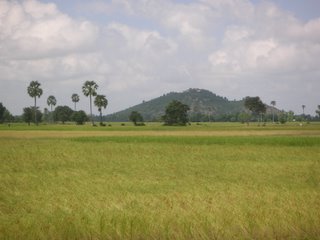
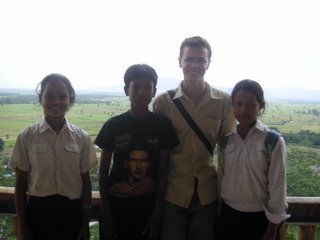
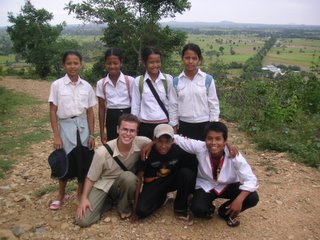
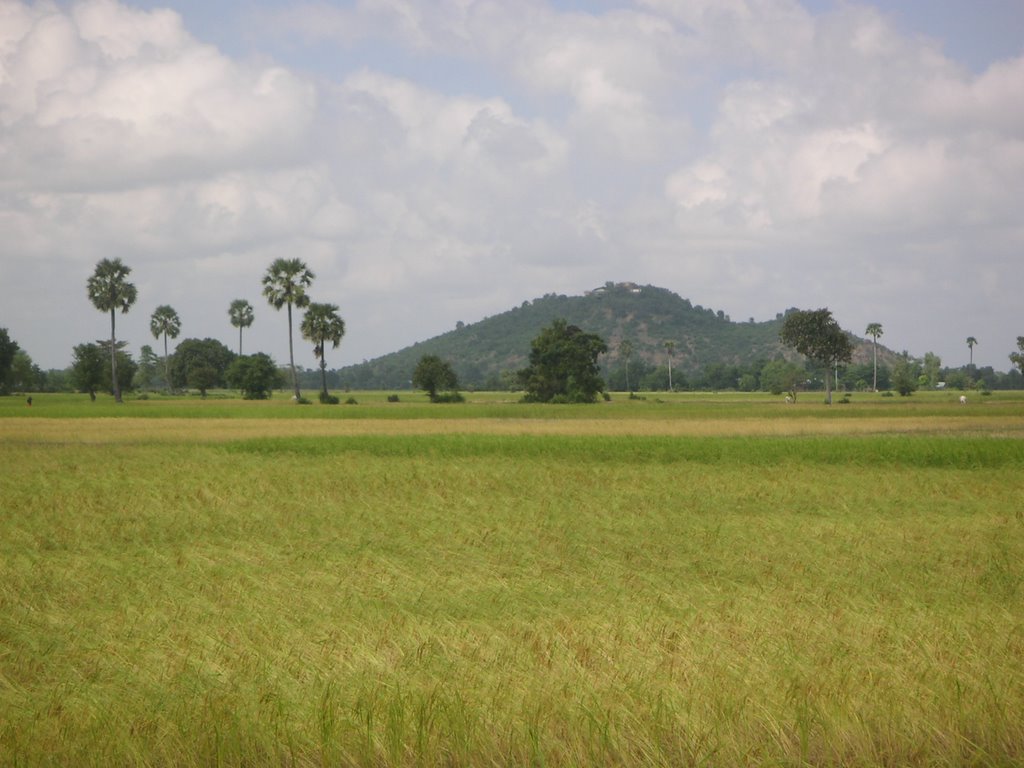
Some of the students in the smote class and I recently had a chance to hike up the mountain pictured below. The view from the top is incredible, and I'm afraid that the photos below don't really capture that. I will write more about my experiences here soon, but in short, living in this village has been one of the happiest times of my life. The friends I've made, the kindness of the neighbors, the beauty of the landscape, the talent of my fellow students of smote, the wisdom of my teachers--all are indescribable and I feel very grateful to be here.


Subscribe to:
Posts (Atom)