I'm been searching all over for some missing issues of Kambuja Suriya, the historic Khmer academic journal. I wonder if anyone knows of where a complete collection might be found. I've looked at most major libraries in the U.S., France, Australia and Cambodia and still can't find the following issues:
1947 (no. 1, 2,3) 1948 (no. 6,9), 1952 (no. 9), 1967 (no. 9,10,11,12), 1968 (no. 7,8,9,10,11,12), 1973 (no. 1,4,7,8,9), 1974 (no. 4,10,11,12), 1975 (any)
Even the Buddhist Institute (which published the journal) and the EFEO don't have these issues, but I surmise they must be somewhere!
Monday, January 05, 2009

Tuesday, August 19, 2008
A snippet of field research
Gathering in the early morning light, Sarin, Samath, Dominique, Pheara and myself piled into the Toyota Camry and headed out of Phnom Penh across the Chrouy Changva bridge. National Road #6, which weaves through small hills and vast fields on its way Kompong Cham province and eventually to Siem Reap and Angkor Wat on the opposite side of the country, nearly burst at the seams from excess traffic. We traveled for several hours, narrowly avoiding collosions with overloaded freight trucks, Landcruisers carrying members of parliament, endless parades of motorcycles and flatbed trucks piled up with cheering supporters of various political parties. Around nine in the morning we passed by a traditional pagoda entrance bearing the inscription, "Vatt Dhammalanka".
I directed us down the narrow dirt road under the pagoda gate. The scent of deep red earth filled my nose as I recalled how scholars in Phnom Penh had told me about Vatt Dhammalanka. I couldn't remember why, however. We rolled down our windows and shouted at passing firewood gatherers traveling back to the main road by bicycle, "Do you how far it is to Vatt Dhammalanka?" "I haven't heard of it, uncle!" came the response. We kept going anyway.
After several kilometers a hill to the right became visible, the narrow spires of the vihara peaking out through the trees. We all hoped that wouldn't be Vatt Dhammalanka, because the road may have been of the non-existent sort. We were deep in the countryside now.
Turns out our hopes came true. Vatt Dhammalanka was just ahead of us, at the bottom of the hill, surrounded by a wide variety of trees. We drove in and parked. But a quick talk with the monks there revealed that this was not the temple we were looking for.
"Yes, we practice the traditional ways here. But if you want to study about dharma songs, then you'll need to go to Vatt Proes Mas," a young monk informed us.
Vatt Proes Mas, the "Pagoda of the Golden Stag," as my friend John Marston had reminded me the other day in Phnom Penh. Yes, this would be a true traditionalist temple. It would be another seven kilometers down a unbearably rough road. Unbearable for those not driving, that is. Some passengers requested to stop along the way, at times to admire the elegant scenery and at times to vomit into the rice paddies which lined the road. If we hadn't been blessed with marvelous sunny weather that day, there would have been no chance of us getting through.
The temple sat nestled in a thicket between the village and a small hill. We drove in under the main entrance gate, admiring the classical carvings that adorned the spacious vihara. Parking the car near a large monastic dwelling, we got out to the sound several dogs barking from inside the building. Cautiously, I approached the entrance, only to be confronted by canine jaws chewing at my pant legs. Another member of our shouted, "Need we worry about the dogs?" A gruff voice from inside building answered, "No, not at all!" We removed our shoes and stepped inside.
The gruff voice belonged to the abbot of the temple. He sat on a bed smoking a hand-rolled leaf cigarette, his robes in disarray. A few novice monks sat on the floor around him, tending to him with large fans and stroking the dogs' backs. The abbot motioned for us to sit as the novices brought in woven plastic mats for us to sit on.
We bowed three times before the abbot and introduced ourselves to him. His speech, colorful and full of grunts, seemed perfectly matched to his wide smile. My interview with him was long and frequently interrupted by brilliant smot and dharma songs from him and other monks his junior. At one point I was asked to smot too, in Khmer and Thai and Lao and Vietnamese and English styles. I felt a powerful sense of exchange there, a powerful sense that our presence was welcome in quirky way, that Dharma was looking for itself.
We left from there to head off to a string of other temples, Vatt Bhumi Bnau, Vatt Brah Trabamn…
I directed us down the narrow dirt road under the pagoda gate. The scent of deep red earth filled my nose as I recalled how scholars in Phnom Penh had told me about Vatt Dhammalanka. I couldn't remember why, however. We rolled down our windows and shouted at passing firewood gatherers traveling back to the main road by bicycle, "Do you how far it is to Vatt Dhammalanka?" "I haven't heard of it, uncle!" came the response. We kept going anyway.
After several kilometers a hill to the right became visible, the narrow spires of the vihara peaking out through the trees. We all hoped that wouldn't be Vatt Dhammalanka, because the road may have been of the non-existent sort. We were deep in the countryside now.
Turns out our hopes came true. Vatt Dhammalanka was just ahead of us, at the bottom of the hill, surrounded by a wide variety of trees. We drove in and parked. But a quick talk with the monks there revealed that this was not the temple we were looking for.
"Yes, we practice the traditional ways here. But if you want to study about dharma songs, then you'll need to go to Vatt Proes Mas," a young monk informed us.
Vatt Proes Mas, the "Pagoda of the Golden Stag," as my friend John Marston had reminded me the other day in Phnom Penh. Yes, this would be a true traditionalist temple. It would be another seven kilometers down a unbearably rough road. Unbearable for those not driving, that is. Some passengers requested to stop along the way, at times to admire the elegant scenery and at times to vomit into the rice paddies which lined the road. If we hadn't been blessed with marvelous sunny weather that day, there would have been no chance of us getting through.
The temple sat nestled in a thicket between the village and a small hill. We drove in under the main entrance gate, admiring the classical carvings that adorned the spacious vihara. Parking the car near a large monastic dwelling, we got out to the sound several dogs barking from inside the building. Cautiously, I approached the entrance, only to be confronted by canine jaws chewing at my pant legs. Another member of our shouted, "Need we worry about the dogs?" A gruff voice from inside building answered, "No, not at all!" We removed our shoes and stepped inside.
The gruff voice belonged to the abbot of the temple. He sat on a bed smoking a hand-rolled leaf cigarette, his robes in disarray. A few novice monks sat on the floor around him, tending to him with large fans and stroking the dogs' backs. The abbot motioned for us to sit as the novices brought in woven plastic mats for us to sit on.
We bowed three times before the abbot and introduced ourselves to him. His speech, colorful and full of grunts, seemed perfectly matched to his wide smile. My interview with him was long and frequently interrupted by brilliant smot and dharma songs from him and other monks his junior. At one point I was asked to smot too, in Khmer and Thai and Lao and Vietnamese and English styles. I felt a powerful sense of exchange there, a powerful sense that our presence was welcome in quirky way, that Dharma was looking for itself.
We left from there to head off to a string of other temples, Vatt Bhumi Bnau, Vatt Brah Trabamn…
Sunday, October 29, 2006
Master Prum Ut
I lived and studied with Master Prum Ut extensively in 2005 and 2006, and the story of his life plays a lot into my own understanding of smot and of Cambodian Buddhism. May he be healthy, well and live long!
Master Prum Ut was born into a family of rice farmers in Ka Yiew village, Kompong Speu province. Like his other brothers and sisters, Prum Ut grew up helping his parents eke out a living from the land by tending cattle, planting fruit trees, harvesting rice, and all of the other labors required of rural life. However, from as early as thirteen, he developed an ear for the beautiful and haunting strains of smot chanting, a complex and demanding way of melodically reciting Khmer poetry, which filled the village or the local temple whenever there was a funeral or other Buddhist ceremony.
Prum Ut did not have a chance to study, however, until he ordained as a novice monk at the age of fifteen. As a young monk at Wat Suvannagiri (Gold Mountain Temple), near his native village in Kompong Speu, he learned to read Khmer and Pali texts, memorizing the simple, monotone chants that form the rhythm of monastic life. After three years in robes, Prum Ut realized that the time was right to begin his study of the art of smot chanting.
To the east of Wat Suvannagiri lived a well-known master of smot poetical recitation named Toeung Phan, an ex-monk who had studied under the revered Palat Un, undoubtedly the most well-known and influential chanting master of the past century, whose renown even continues today in the few sound recordings that survive from his era. Toeng Phan spent most of his time as a monk in Kandal province, near the capital of Phnom Penh, where his reputation grew in light of his gifts for preaching and the smot chanting of Buddhist texts.
Both Palat Un and Toeung Phan had famously intricate vocal styles and high tenor voices that were difficult to imitate, and Prum Ut initially struggled in his efforts to learn this art. The first song he learned, “The Lamentation of Bimba,” tells the story of the Buddha returning to the palace of his birth and encountering his wife Yasodhara Bimba.
O Bimba! Rise and show your face!
Whence comes this sadness that knows no end?
In your heart you have developed so much virtue
And trustworthiness; come now to pay respect to the Lord.
The Lord Buddha has now returned;
Why do you persist in your tears?
If you are upset, he will go back—
How then will your wish be fulfilled? (Author unknown, trans. T.W.)
When Prum was studying this text under his teacher Toeung Phan, his teacher was so demanding in terms of vocal technique that it took ten days just to learn the first two words, “O Bimba,” in the correct way. But after his initial struggles, Prum Ut learned quickly and with his stunning tenor voice, soon proved himself to a worthy disciple and successor of Toeung Phan and Palat Un.
Prum Ut studied under his master for several years, learning many important chanting styles and key texts, both in the Pali and Khmer languages. Even when he knew only the first two words of “The Lamentation of Bimba,” he began chanting for Buddhist ceremonies, including rituals to consecrate religious images, to transfer spiritual merit to the deceased, and to accompany the dying in their final moments. He was widely admired for his light, unforced voice, rich in ornamentation and a special vocal quality known in Khmer as oeun, a precise and carefully controlled vibrato unique to this art form.
Prum Ut left the monkhood and started a family of his own six years after his ordination. He continued to chant at many religious gatherings until 1975, when the Khmer Rouge took control of the country. The Marxist government abolished all forms of religion practice and uprooted most forms of traditional culture, including music, literature and dance. Soldiers ordered Prum Ut and family to neighboring Takeo province, where he worked in the fields. His wife, his children and many siblings perished in the famine that soon followed.
As might be expected of a former monk whose education was steeped in Buddhist texts, Prum Ut relates his experience during the genocide through a story from the Buddha’s time about a young woman named Patacara, who, though a series of unfortunate events, loses her husband, her parents, and her two small children in a single day. She then loses her mind and wanders naked through the streets until she encounters the Buddha, who urges her to reflect on the fleeting nature of life. She comes to her senses and later ordains as a nun and becomes a revered teacher. Prum Ut uses this story to illustrate the importance of understanding the impermanence of human existence. The many texts in the smot tradition that expound this teaching were his inspiration and refuge in surviving spiritually from the wake of the Khmer Rouge era:
Human bodies and minds never last long; they always break apart.
All materiality without exception
Goes from birth to death, from death to birth in a new life,
Without release or peace—all beings are thus!
Old age comes on naturally,
Just as human bodies and minds meet destruction,
Thoughts scattering away into deep silence—
Nothing can last forever. (excerpted from Chey Mai,“Sukhumalakkhana,” trans. T.W.)
Prum Ut speaks of personal experience when he insists of the importance of this tradition in coming to terms with life after so much loss. In the early 1980’s, Prum Ut renown grew as he was frequently invited to chant at temples and homes both within Kompong Speu and in neighboring provinces. He often accompanied monks who preached stories about the Buddha’s lives, chanting the appropriate texts in the smot style in the course of the monks’ narration.
But throughout that decade and into the 1990’s, as the new generation rose to power and foreign influences began to push traditional culture further towards the margins of society, Prum Ut was invited less and less to offer performances of smot chanting. In many parts of the country, poor quality cassette tapes replaced live smot, and fewer and fewer people knew how to appreciate his art form.
Although Prum Ut taught privately on an informal basis for many years, it was not until 2004 when Cambodian Living Arts invited him to join their faculty and teach local youth professionally. He now teaches fifteen students with Assistant Master Keot Ran in a small classroom in Kompong Speu.
Wary of current trends in popular Khmer culture and music, which in his words consists of “seventy percent romantic songs,” he laments that nowadays when some people listen to smot chanting they simple turn away and “chatter idly.” Although he refrains from criticizing such people, he insists on the importance of passing this tradition down to the next generation so that those that do in fact find meaning and value in this art form may have it to study and appreciate. “I am afraid that after I go, then what? I fear that this tradition may not last long,” he says. Many of the chants in his extensive repertoire are rarely heard anymore, and some, like “The Lamentation of Bimba,” are so rare and difficult to learn that barely anyone else can chant them anymore, despite their past popularity with such masters as Palat Un and Toeung Phan. “I am very happy that [CLA] can support these children in their study,” he says, “so that we can continue [this tradition] into the future.”
Master Prum Ut was born into a family of rice farmers in Ka Yiew village, Kompong Speu province. Like his other brothers and sisters, Prum Ut grew up helping his parents eke out a living from the land by tending cattle, planting fruit trees, harvesting rice, and all of the other labors required of rural life. However, from as early as thirteen, he developed an ear for the beautiful and haunting strains of smot chanting, a complex and demanding way of melodically reciting Khmer poetry, which filled the village or the local temple whenever there was a funeral or other Buddhist ceremony.
Prum Ut did not have a chance to study, however, until he ordained as a novice monk at the age of fifteen. As a young monk at Wat Suvannagiri (Gold Mountain Temple), near his native village in Kompong Speu, he learned to read Khmer and Pali texts, memorizing the simple, monotone chants that form the rhythm of monastic life. After three years in robes, Prum Ut realized that the time was right to begin his study of the art of smot chanting.
To the east of Wat Suvannagiri lived a well-known master of smot poetical recitation named Toeung Phan, an ex-monk who had studied under the revered Palat Un, undoubtedly the most well-known and influential chanting master of the past century, whose renown even continues today in the few sound recordings that survive from his era. Toeng Phan spent most of his time as a monk in Kandal province, near the capital of Phnom Penh, where his reputation grew in light of his gifts for preaching and the smot chanting of Buddhist texts.
Both Palat Un and Toeung Phan had famously intricate vocal styles and high tenor voices that were difficult to imitate, and Prum Ut initially struggled in his efforts to learn this art. The first song he learned, “The Lamentation of Bimba,” tells the story of the Buddha returning to the palace of his birth and encountering his wife Yasodhara Bimba.
O Bimba! Rise and show your face!
Whence comes this sadness that knows no end?
In your heart you have developed so much virtue
And trustworthiness; come now to pay respect to the Lord.
The Lord Buddha has now returned;
Why do you persist in your tears?
If you are upset, he will go back—
How then will your wish be fulfilled? (Author unknown, trans. T.W.)
When Prum was studying this text under his teacher Toeung Phan, his teacher was so demanding in terms of vocal technique that it took ten days just to learn the first two words, “O Bimba,” in the correct way. But after his initial struggles, Prum Ut learned quickly and with his stunning tenor voice, soon proved himself to a worthy disciple and successor of Toeung Phan and Palat Un.
Prum Ut studied under his master for several years, learning many important chanting styles and key texts, both in the Pali and Khmer languages. Even when he knew only the first two words of “The Lamentation of Bimba,” he began chanting for Buddhist ceremonies, including rituals to consecrate religious images, to transfer spiritual merit to the deceased, and to accompany the dying in their final moments. He was widely admired for his light, unforced voice, rich in ornamentation and a special vocal quality known in Khmer as oeun, a precise and carefully controlled vibrato unique to this art form.
Prum Ut left the monkhood and started a family of his own six years after his ordination. He continued to chant at many religious gatherings until 1975, when the Khmer Rouge took control of the country. The Marxist government abolished all forms of religion practice and uprooted most forms of traditional culture, including music, literature and dance. Soldiers ordered Prum Ut and family to neighboring Takeo province, where he worked in the fields. His wife, his children and many siblings perished in the famine that soon followed.
As might be expected of a former monk whose education was steeped in Buddhist texts, Prum Ut relates his experience during the genocide through a story from the Buddha’s time about a young woman named Patacara, who, though a series of unfortunate events, loses her husband, her parents, and her two small children in a single day. She then loses her mind and wanders naked through the streets until she encounters the Buddha, who urges her to reflect on the fleeting nature of life. She comes to her senses and later ordains as a nun and becomes a revered teacher. Prum Ut uses this story to illustrate the importance of understanding the impermanence of human existence. The many texts in the smot tradition that expound this teaching were his inspiration and refuge in surviving spiritually from the wake of the Khmer Rouge era:
Human bodies and minds never last long; they always break apart.
All materiality without exception
Goes from birth to death, from death to birth in a new life,
Without release or peace—all beings are thus!
Old age comes on naturally,
Just as human bodies and minds meet destruction,
Thoughts scattering away into deep silence—
Nothing can last forever. (excerpted from Chey Mai,“Sukhumalakkhana,” trans. T.W.)
Prum Ut speaks of personal experience when he insists of the importance of this tradition in coming to terms with life after so much loss. In the early 1980’s, Prum Ut renown grew as he was frequently invited to chant at temples and homes both within Kompong Speu and in neighboring provinces. He often accompanied monks who preached stories about the Buddha’s lives, chanting the appropriate texts in the smot style in the course of the monks’ narration.
But throughout that decade and into the 1990’s, as the new generation rose to power and foreign influences began to push traditional culture further towards the margins of society, Prum Ut was invited less and less to offer performances of smot chanting. In many parts of the country, poor quality cassette tapes replaced live smot, and fewer and fewer people knew how to appreciate his art form.
Although Prum Ut taught privately on an informal basis for many years, it was not until 2004 when Cambodian Living Arts invited him to join their faculty and teach local youth professionally. He now teaches fifteen students with Assistant Master Keot Ran in a small classroom in Kompong Speu.
Wary of current trends in popular Khmer culture and music, which in his words consists of “seventy percent romantic songs,” he laments that nowadays when some people listen to smot chanting they simple turn away and “chatter idly.” Although he refrains from criticizing such people, he insists on the importance of passing this tradition down to the next generation so that those that do in fact find meaning and value in this art form may have it to study and appreciate. “I am afraid that after I go, then what? I fear that this tradition may not last long,” he says. Many of the chants in his extensive repertoire are rarely heard anymore, and some, like “The Lamentation of Bimba,” are so rare and difficult to learn that barely anyone else can chant them anymore, despite their past popularity with such masters as Palat Un and Toeung Phan. “I am very happy that [CLA] can support these children in their study,” he says, “so that we can continue [this tradition] into the future.”
Thursday, October 19, 2006
Biography of Master Koet Ran

Assistant Master Koet Ran’s father, a former monk, kept a fragile paper manuscript in his house, and in his spare time, he would teach his young daughter the art of smot chanting. These encounters with her father marked the beginning of Koet Ran’s life-long study of smot, a melodic form of recitation that is one of the most complex and difficult traditional Cambodian vocal techniques.
Koet Ran was born in small village in Kompong Speu province, some forty kilometers from the capital of Phnom Penh. Like most families in this district, Keot Ran and her family were rice farmers. Following the traditional way of learning, she memorized and perfected four chants before she was orphaned at the age of nine.
After her parents’ death, she continued to study the chants and developed an appreciation —uncommon for a young woman— for Buddhist teachings. She married at eighteen, but when the Khmer Rouge took over in 1975, Communist cadres sent her from her homeland. She later ended up near the Thai border, hundreds of kilometers away, working on a communal farm. Soldiers of the regime separated her from her children, sent her to jail, and forced her to watch the killing of her own husband. In the end, she survived and made her way back to Kompong Speu in 1979. She frankly says that her life as an orphan, widow and a bereaved mother allows her to deeply understand smot texts in the Buddhist tradition that tell similar stories of loss and spiritual darkness.
Three years later, she met her current husband, built a new life and has lived with her children and grandchildren in the village of her birth ever since. In the early 1980’s, as Cambodians began to reconstruct their Buddhist culture, Koet Ran took up the study of smot again and was invited to chant at various religious ceremonies, including offerings, sermons, and funerals. Inspired by the resurgence of religion in her country, she memorized many texts—an excellent memory being both a sign of wisdom and a vital prerequisite for the transmission of oral literature— and developed a large repertoire of chants.
Koet Ran lost her vision due to a farming accident in the early 1990’s. Despite her difficulties, she continued to learn and memorize new chants with the aid of cassette tapes and her sighted husband. Three years ago, she was asked to join the faculty of CLA as an Assistant Master, and has been training fifteen young students from local villages in the art of smot chanting since that time.
Koet Ran’s chanting style is plain and unadorned, without an excess of vibrato, and uncannily steady in pitch and tone. Her full and powerful voice expresses the religious stories told by many chanting texts with great feeling, focused concentration, and compassion. Particularly when chanting the texts that connect deeply to her own life and her experiences of loss, her performances often bring her audience to tears. It is rare that someone is not moved by her presence and by her art. One of the chants dearest to Keot Ran relates the story of an orphan:
Night! O night, how long and how deep!
Before I'd sleep, you'd hold me tight.
Mother, you'd sing all through the night
Lest I, in fright, should wake and cry.
Mother, I wail for your grace—
Ne'er again your face will I see.
Alone, I burn in agony.
What misery, day after day.
(my translation of an excerpt from “Orphaned Child.” Unknown author)
In the face of her difficulties as a blind woman and as an involuntary witness to unspeakable atrocities, Keot Ran remains very committed to the ideals that underlie the chants for which she has become known. She considers the teaching of smot chanting to children and youth an important opportunity to pass on the wisdom of reflection and compassion. She insists on the benefits of studying chanting texts as a way to see the impermanence of life and the urgency to give to and treat others with dignity.
In her own words, “When one studies [Dharma song], one studies the teachings that will make one calm and free from craving and defilement. One calms greed, hatred, and delusion…Accomplishing things by one’s own sweat and blood, one knows the importance of others [and] contemplates what is right and wrong.” As she searches for new song to teach to her students, she remains inspired by the power of smot, a power she believes to be essential to the development of Khmer society for generations to come.
Monday, October 16, 2006
Meditation for Children

I was going through some of the books I read when I was in Cambodia when I came across this gem, a slim volume entitled "Meditation for Children." Unlike other books about meditation I saw in Cambodia, which tended to treat it as a subject for philosophical discussion or an opportunity to memorize yet more of Buddhaghosa's Visuddhimagga, Bhikkhu Ma Surin's book is charmingly down to earth and filled with practical exercises.
As someone used to hearing the principles of mindfulness explained in English, I found this book expounded techniques of sati with grace and ease, avoiding excessive Pali terms to eluciade the principles of meditation in fresh terms. It not only deals with sitting meditation and mindfulness of breathing, but also goes through many practical techniques for studying, playing sports, and doing household chores. Of particular interest was the way it integrated Buddhist teachings of filial piety into its discussion of meditation. Western books on the Dharma are often all to silent on this critical point, but Ven. Ma Surin's book emphasizes that meditation and caring for one's parents must go hand in hand.
As the cover shows, it is also filled with pleasant illustrations. In all, a delightful work that deserves to be translated into many languages. Look for it in Phnom Penh bookstores.
Sunday, October 15, 2006
Thinking about food
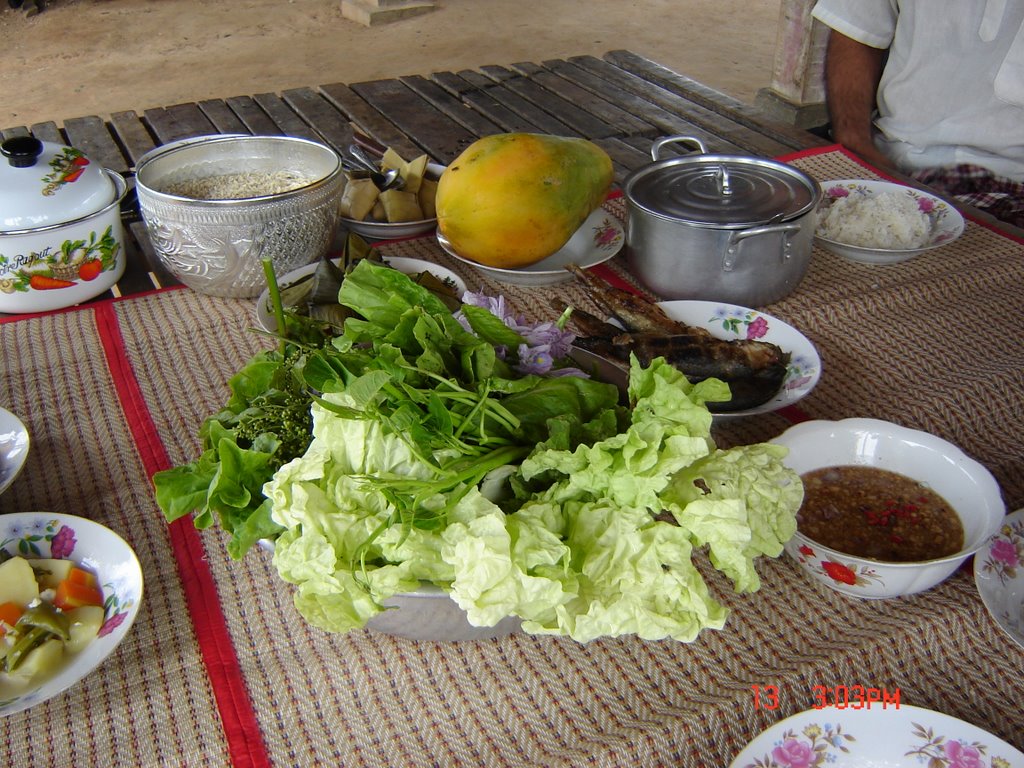
I can't say I miss all Khmer food, because my memories of food in Phnom Penh are often accompanied by memories of having an IV shoved up my arm. But I still miss the food I had when I lived out in Kompong Speu province with Master Prum Ut and his family. Fresh papaya, ambok (a sort of toasted cereal made from mashed rice), local greens, and delectable peanut and lemon-juice sauces--just the thought of them is enough to make my mouth water. We only had more extravagant meals like this one when visitors came, but each meal there was its own treasure, and I never got sick from it or of it.
Last night I had Khmer food for the third time since I got back to California. Interestly enough, we had ban chau, a sort of Khmer (well, actually, Vietnamese) pancake stuffed with meat or vegetables, which was what I ate at the last dinner I had before I entered Wat Bo as a monk last February.
Saturday, October 14, 2006
Digital Manuscripts
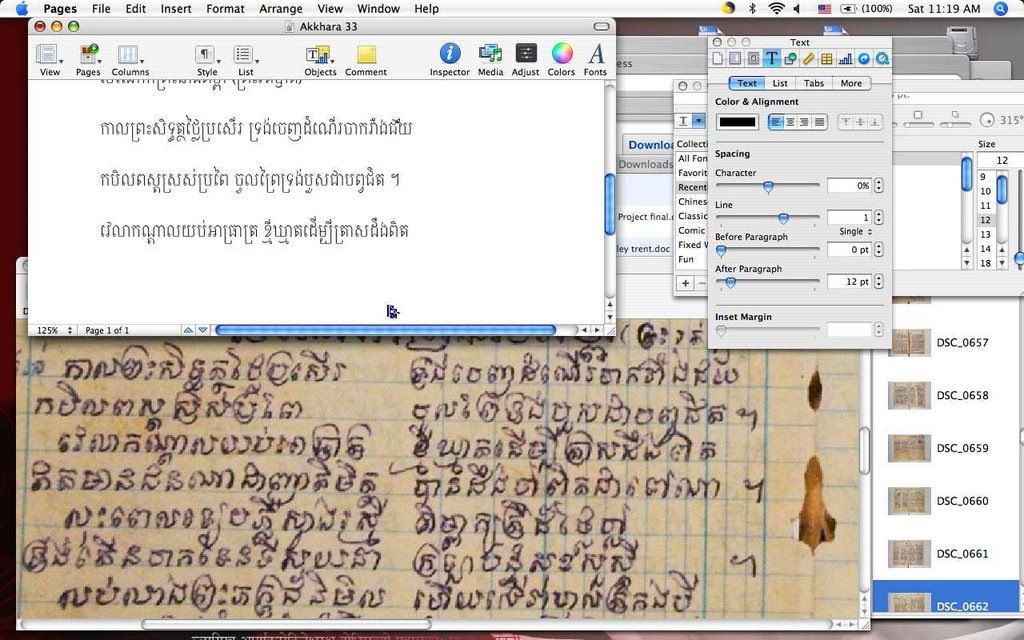
I know it has been a long time since I have updated this blog, but as I settle in more at Stanford and begin to work on my Cambodia projects again, hopefully I will be posting here more often.
A current project I am working on is typing up various Dharma song manuscripts I came across during my stay in Cambodia. Several of them, such as this wonderful "smot journal" lent to me by Suon Bunrith of Amrita Performing Arts (www.amritaperformingarts.org), I was able to capture in the form of digital images. I am now in the process of typing some of the rarer songs into the computer with the Khmer Unicode font, which is a significant improvement over earlier imput methods.
Monday, September 25, 2006
Return
Now that I have returned to California after 13 some months abroad in Cambodia, it is a bit intimidating to write about my experiences there. I suppose it is only myself who would be capable of such intimidation, but nevertheless I remain in awe of the sheer amount of territory I have observed and experienced without putting it into words. Back in the comfort of life at Stanford, glorious September weather and the eerie security from hazards, Cambodia suddenly seems far away, connected to this realm only through memory, books, sounds, images, and the occasional person I meet who has roots there.
Then there is the issue of the validity of the work I was doing there. The world of scholarship is one that it not entirely foreign to me, but it is certainly one that I have never had a voice in. And now that I do have the knowledge and the experience to make a contribution, will my voice be a valid one? This is where, perhaps, I am looking for a mentor, to search for real meaning in my work and rediscover what I innately know to be the real joy of writing.
But where to start? Cambodia unfolds like waterfall in my memory-- slow at first, then falling in separate streams, each of great intensity, before rushing on into the roaring stream below. The lines between scholarship and memory and also unclear. To what extant can I authoritatively write about my experience? Then again, I suppose, to what extent can I really write about books and the experiences of others. I somehow sense that there will be a voice that emerges from all this, from the growing pains of nascent adulthood, the trials of moral decisions, the quest for a spiritual life, and the struggle to “save” traditional Khmer culture. It’s a journey all right, but who is it really for? I may understand a little bit of my own place in it, at least in terms of my own journey. But how will I contribute to the journeys of others, the journeys of Khmer students, monks and musicians, of masters and apprentices?
I have only begun to unearth the mound of material I have collected, which looms above my desk and fills my consciousness with the thirst of discovery. And for so long my writing has stalled, and I knew inside that I just needed to let this writing come out, without judgment or pre-planned outlines. It feels wonderful, really quite wonderful, to be writing again.
Yesterday I went to Nagara Dhamma temple in SF for their Phchum Ben ceremony, which above all struck me as an American affair. Unlike my previous visit, in which I mostly listened to a bhikkhu for Surin talk in his heavily-accented Khmer, I barely said a word to the monks this time around. The same familiar chants were a always a deep joy to partake in, and I felt a genuine spiritual atmosphere that I had not really sensed in Cambodia. In particular, it felt much more tender and genuine that Wat Campuh k’aek, and the community feeling was much stronger than at Wat Bo. The Thai chanting in Pali was beautiful and unforgettable in a way, and it carried the same kind of resonance of the chanting of the Tibetan Gyuto monks. I also felt like I was building my first connections in the Khmer American community. Obviously, but perhaps surprising as well, was the reaction to the attendees when I spoke Khmer, which was basically the same reaction as in Cambodia. Almost every conversation I had was bilingual, which made for a rich interplay of language and idiom, and it was especially refreshing to be speaking the tongue that had become so natural to me when I was in Cambodia. A chance encounter with a Christian monk in beautiful purple robes who has close connections to Buddhist monks in Cambodia, Father Nazarene, seems to be a fortunate opportunity to continue to connect with the Khmer Buddhist community.
But what I am really here to write about is my research on the Cambodian Dharma song tradition, one that continues to speak to me and pervade my inner life. I continue to hear the strains of “yo vo ananda” and “thvay phka” in my head as I walk around campus, and I often wonder if these songs aren’t the most beautiful thing on earth. The Dharma that they proclaim is slowly ripening as I understand them more and more.
Then there is the issue of the validity of the work I was doing there. The world of scholarship is one that it not entirely foreign to me, but it is certainly one that I have never had a voice in. And now that I do have the knowledge and the experience to make a contribution, will my voice be a valid one? This is where, perhaps, I am looking for a mentor, to search for real meaning in my work and rediscover what I innately know to be the real joy of writing.
But where to start? Cambodia unfolds like waterfall in my memory-- slow at first, then falling in separate streams, each of great intensity, before rushing on into the roaring stream below. The lines between scholarship and memory and also unclear. To what extant can I authoritatively write about my experience? Then again, I suppose, to what extent can I really write about books and the experiences of others. I somehow sense that there will be a voice that emerges from all this, from the growing pains of nascent adulthood, the trials of moral decisions, the quest for a spiritual life, and the struggle to “save” traditional Khmer culture. It’s a journey all right, but who is it really for? I may understand a little bit of my own place in it, at least in terms of my own journey. But how will I contribute to the journeys of others, the journeys of Khmer students, monks and musicians, of masters and apprentices?
I have only begun to unearth the mound of material I have collected, which looms above my desk and fills my consciousness with the thirst of discovery. And for so long my writing has stalled, and I knew inside that I just needed to let this writing come out, without judgment or pre-planned outlines. It feels wonderful, really quite wonderful, to be writing again.
Yesterday I went to Nagara Dhamma temple in SF for their Phchum Ben ceremony, which above all struck me as an American affair. Unlike my previous visit, in which I mostly listened to a bhikkhu for Surin talk in his heavily-accented Khmer, I barely said a word to the monks this time around. The same familiar chants were a always a deep joy to partake in, and I felt a genuine spiritual atmosphere that I had not really sensed in Cambodia. In particular, it felt much more tender and genuine that Wat Campuh k’aek, and the community feeling was much stronger than at Wat Bo. The Thai chanting in Pali was beautiful and unforgettable in a way, and it carried the same kind of resonance of the chanting of the Tibetan Gyuto monks. I also felt like I was building my first connections in the Khmer American community. Obviously, but perhaps surprising as well, was the reaction to the attendees when I spoke Khmer, which was basically the same reaction as in Cambodia. Almost every conversation I had was bilingual, which made for a rich interplay of language and idiom, and it was especially refreshing to be speaking the tongue that had become so natural to me when I was in Cambodia. A chance encounter with a Christian monk in beautiful purple robes who has close connections to Buddhist monks in Cambodia, Father Nazarene, seems to be a fortunate opportunity to continue to connect with the Khmer Buddhist community.
But what I am really here to write about is my research on the Cambodian Dharma song tradition, one that continues to speak to me and pervade my inner life. I continue to hear the strains of “yo vo ananda” and “thvay phka” in my head as I walk around campus, and I often wonder if these songs aren’t the most beautiful thing on earth. The Dharma that they proclaim is slowly ripening as I understand them more and more.
Subscribe to:
Posts (Atom)